Daiichi Sankyo · flagship
Daiichi Sankyo pairs LINK AI drafting with TrialAssure’s medical writers
- Up to 80%
- faster PLS delivery
- ~50%
- lower cost per document

TrialAssure® gives transparency and disclosure teams greater visibility across global registration, results disclosure, anonymization, and compliance tracking. Purpose-built technology and regulatory expertise help teams manage complex requirements with confidence.
PRM001 Zinon Regax, Inc.
Study Dates: 20 Jan 2025 (first subject first visit) to 14 Jun 2026 (last subject last visit)
| Event | Deadline | Due Date |
|---|---|---|
| FDAAA 801 / ClinicalTrials.gov | ||
| ClinicalTrials.gov registration | Within 21 calendar days of enrolling the first participant | |
| Standard results submission | Within 12 months of the primary completion date | Not stated |
| EU CTR / CTIS | ||
| End-of-trial notification | 15 days from trial end | |
| Summary of results + lay summary | 12 months from end of trial in all Member States concerned | |
Simulated product interface · fictional study data (“Zinon”, Regax Inc.)
For clinical trial transparency & disclosure teams
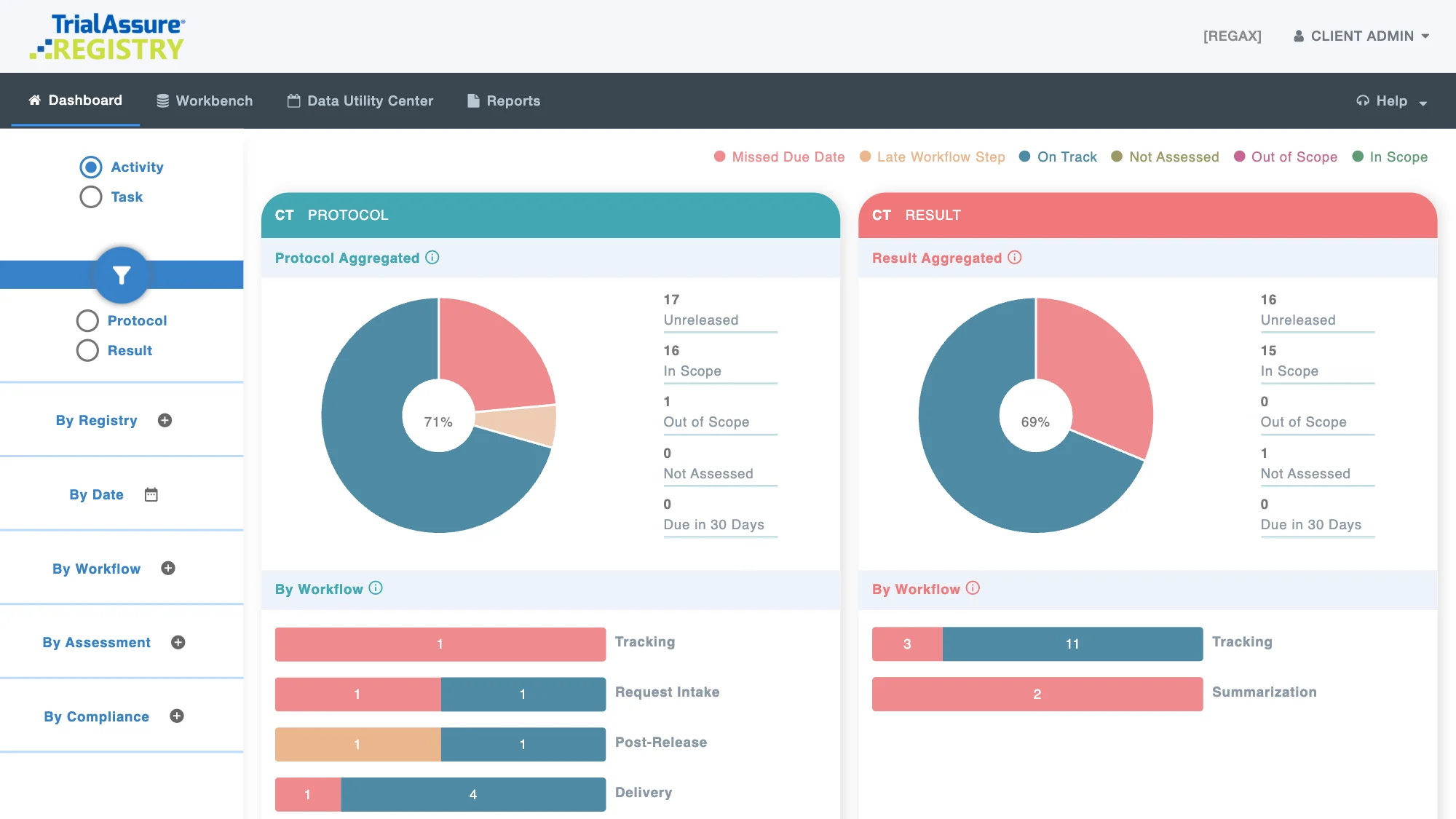
Clinical trial disclosure requirements vary by registry, study, and milestone. TrialAssure REGISTRY® brings obligations and deadlines together in one place, helping teams see what is due, what needs attention, and where action is required across the portfolio.
WHAT KEEPS DISCLOSURE LEADS UP AT NIGHT
Tracked by the rules engine, not your spreadsheet, and kept current by our clinical trial transparency specialists as requirements change.
Surfaced before they’re urgent. U.S. results-reporting violations now run up to $15,107 per day, and missed deadlines are increasingly flagged publicly.
Cleared at up to 80% faster processing, with a quantified re-identification risk position that survives challenge.
One dataset feeds 40+ registries, and customers are seeing improved 21-day registration performance by up to 50%.
Answered in one dashboard, with traceable audit evidence already assembled.
One platform carries each study from registration to disclosure, so data is never re-keyed or lost between teams.
TrialAssure REGISTRY® manages registration and results disclosure across applicable global registries using one study dataset. The rules engine helps identify requirements and calculate deadlines based on study milestones.
TrialAssure ANONYMIZE® applies quantitative, risk-based anonymization across documents, datasets, and images, with re-identification risk assessment and supporting documentation built into the process.
TrialAssure LINK® AI supports the drafting of results summaries and plain language summaries inside Microsoft Word using your templates and source materials, giving medical writers more capacity for review, interpretation, and final approval.
See clinical trial transparency compliance across the portfolio, identify approaching deadlines, and maintain a traceable record of submissions, decisions, and key activity to support audit readiness.
* Results vary by portfolio mix, registry footprint, and review policy. “Up to” means the ceiling, not the average.
| Capability | TrialAssure | Registry-only point tools | Manual (spreadsheet + email + services) |
|---|---|---|---|
| Registry coverage | 40+ registries from one dataset, one rules engine | Registration only — anonymization and PLS live elsewhere | Coverage depends on who you hire, per registry |
| Deadline tracking | Auto-calculated and recalculated as steps complete | Due-date library, but siloed from anonymization | Manual trackers that only a person keeps current |
| Anonymization | Risk-based ANONYMIZE, up to 80% faster, in-platform | Not included — a separate tool or vendor | Outsourced per document, slower and per-project |
| Results & PLS drafting | LINK AI drafts in Word on your templates | Out of scope | Billed hours, restarted each study |
| Audit trail & proof | Every submission and decision logged by design | Registration logs only | Reconstructed from email and files after the fact |
| When you’re short-staffed | License, co-deliver, or hand us the portfolio — one system | Buy another tool | Scope another engagement, lose continuity |
Daiichi Sankyo · flagship
TrialAssure’s expertise and technology make navigating complex regulatory frameworks seamless.
AUDIT-READY BY DESIGN
AI surfaces the deadline and drafts the content; your disclosure team reviews, approves, and stays accountable. Every action is logged.
Visit the Trust Center →The 21-day registration clock and 12-month results window, with penalties up to $15,107/day.
See the requirement →Registration, results, and anonymized documents through the EU portal on the 12-month clock.
See the requirement →Lay summaries in local languages — now required in 30+ countries — drafted with LINK AI.
See the requirement →Anonymized clinical reports and the anonymization report, on EMA’s post-opinion clock.
See the requirement →Public release of clinical information on the same risk-based anonymization model.
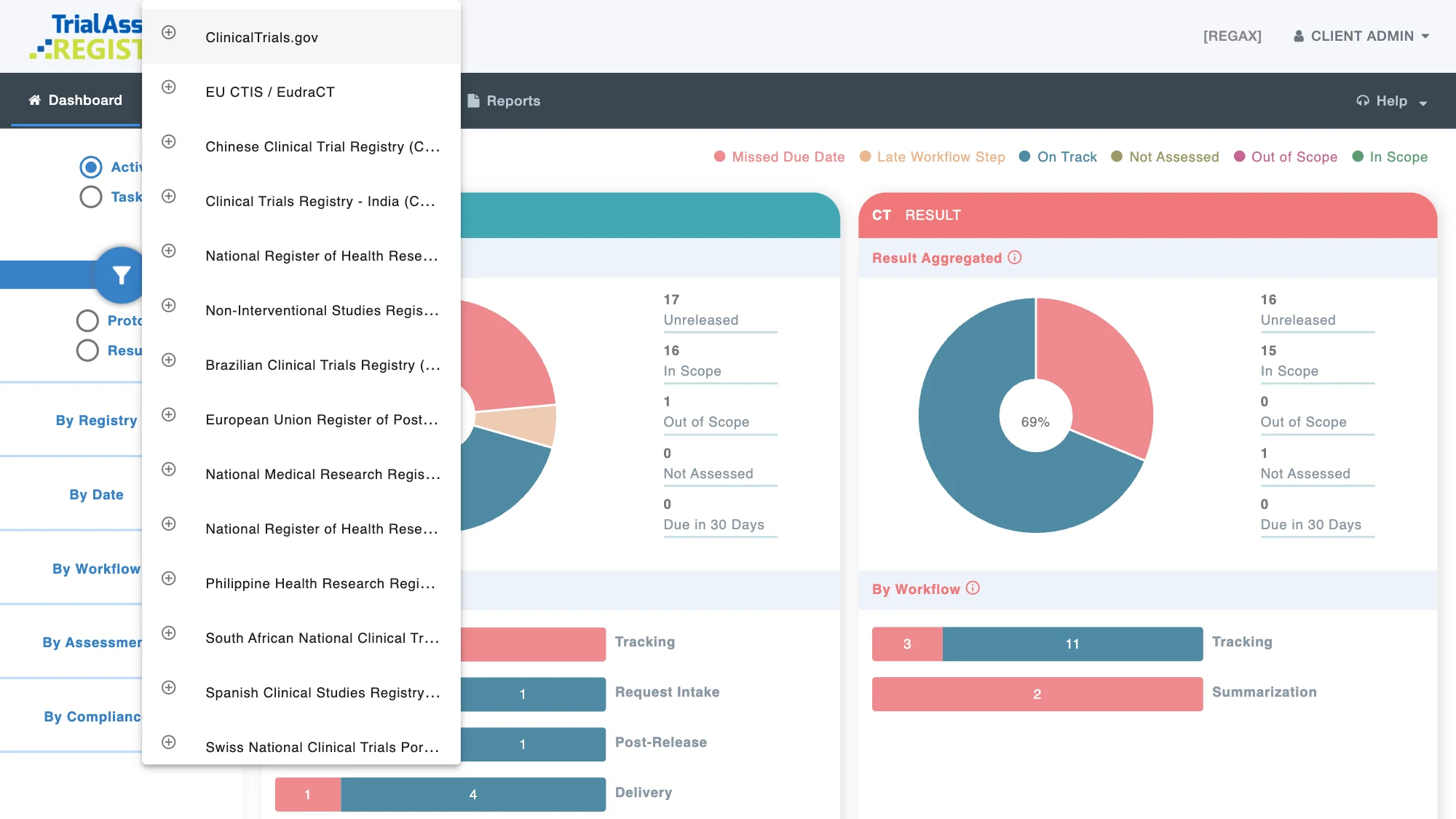
See the requirement →The home base: register and disclose across 40+ registries from one system.
Explore REGISTRY →Clinical trial transparency and disclosure teams use TrialAssure to run the full lifecycle on one platform: TrialAssure REGISTRY® for registration and results posting across 40+ registries, TrialAssure ANONYMIZE® for risk-based document anonymization, and TrialAssure LINK® AI for results and plain language summary drafting, with deadline tracking and audit proof built in. 8 of the top 10 clinical development companies use TrialAssure. It replaces the common mix of a registry-only tool, a separate anonymization vendor, spreadsheets, and email.
REGISTRY works from one dataset across 40+ registries and its rules engine auto-calculates each obligation — registration, results, updates, and anonymization windows — then recalculates remaining deadlines when a step completes early or late. The portfolio view puts every study’s status and upcoming deadlines on one dashboard, so nothing depends on a spreadsheet only one person maintains.
In the U.S., results-reporting violations under the FDAAA 801 final rule now carry civil monetary penalties of up to $15,107 per day (21 U.S.C. 333(f)(3)(B); the 2025-adjusted level, still current), and missed deadlines are increasingly flagged publicly on ClinicalTrials.gov. The point of a rules engine is to surface each deadline well before it’s urgent, so the answer is that you don’t reach the penalty stage. See our FDAAA 801 page for the specifics.
Yes — data migration is part of onboarding, not a separate project. We map your existing study records, submission histories, and open obligations into one dataset, then the rules engine recalculates the remaining deadlines for every trial, so nothing resets to zero. Historical submissions stay attached to the study, so the audit trail you have already built survives the switch. The honest limit is export quality: whatever your current tool cannot export cleanly has to be reconciled or re-entered, and we scope that with you before cutover rather than discovering it afterward. Your team keeps working while the migration runs alongside.
A registry-only tool covers registration and results posting; everything else on the disclosure critical path — anonymization, results drafting, plain language summaries, and the compliance evidence — sits with other vendors, and the handoffs between them are where deadlines slip. TrialAssure runs the full lifecycle on one platform: REGISTRY across 40+ registries, ANONYMIZE for risk-based anonymization, and LINK AI for results and summary drafting — one dataset, one rules engine, one audit trail. If your footprint is a single registry with no anonymization or plain language summary obligations, a point tool may be enough; the difference shows up the moment it is not.
Yes. ANONYMIZE performs risk-based, quantitative anonymization on the documents and datasets you publish — measuring re-identification risk against the applicable threshold rather than blacking out pages — and generates the documentation behind your anonymization report. It processes documents up to 80% faster, which matters because a stalled anonymization queue is what turns a manageable posting deadline into a missed one. The same defensible methodology serves CTIS, EMA Policy 0070, and Health Canada PRCI, so one risk position works across jurisdictions. The threshold and its justification stay your decision: specialists review the output, and every transformation is logged and attributable.
Start with what you can actually staff, and change the mix later. Three models run on the same platform: license it and run disclosure yourself, run it alongside our transparency specialists, or hand us the portfolio while you rebuild the team. Because the work happens in one system either way, moving between models changes who holds the queue rather than requiring a migration, and the audit trail stays continuous through the handover. That is the difference from scoping a fresh services engagement each time, which restarts context you already paid for. See Services.
Every submission, field change, approval, and timestamp is logged and attributable to a named user, so the evidence an inspector asks for already exists instead of being reconstructed from email and file shares after the notice arrives. That includes anonymization decisions and the risk documentation behind them, so an anonymization position can still be explained years later by someone who was not in the room. The same record is presented at portfolio level: status per study, what was submitted where, and when. Underneath, TrialAssure is ISO 9001:2015 and ISO/IEC 27001:2022 certified, GDPR-aligned and HIPAA-aligned — the Trust Center has the full posture.
No. TrialAssure is AI Enabled. Human Driven.™ — the software takes the mechanical work, your team keeps the judgment and the accountability. LINK AI drafts results summaries and plain language summaries inside Microsoft Word on your own templates, with source references at statement level, so review is verification against the source rather than rewriting from a blank page. The rules engine surfaces deadlines, but a person approves every submission, and every transformation is logged and attributable. What changes is where your writers spend time: less first-draft assembly and re-keying, more local-language adaptation, scientific judgment, and review.
Our clinical trial transparency specialists monitor the registries and turn each change into an updated rule, so a new field, a changed format, or a shifted clock is maintained centrally instead of being something your team has to discover, interpret, and re-teach itself. Because all 40+ registries work from one dataset and one engine, an updated rule immediately shows which of your studies it touches and recalculates the deadlines it moves — you see the change and its portfolio impact in the same place. Registries do sometimes change with little notice; the engine shortens the gap between the change and your response rather than pretending it away.
Yes. The platform is modular, so you can start with your worst bottleneck: registration and results posting in REGISTRY, or the anonymization queue in ANONYMIZE, adding LINK AI when drafting volume becomes the constraint. Because every module works from the same study dataset and writes to the same audit trail, expanding later means enabling the next part of the lifecycle — not a second integration, a second migration, or a second vendor relationship. Nothing you configure in the first phase has to be rebuilt for the next one.
8 of the top 10 clinical development companies use TrialAssure. The delivery record behind that: 8 million+ pages of documents, 400+ clinical datasets, and 850,000+ pages anonymized with Certara across 250+ projects. On timeliness, customers improved their performance against the 21-day registration target by 50%. Daiichi Sankyo’s plain language summary delivery ran up to 80% faster at ~50% lower cost per document. Results vary by portfolio mix, registry footprint, and review policy — “up to” is the ceiling, not the average. More in our case studies.
TrialAssure supports clinical trial disclosure management across 40+ global registries, with purpose-built technology for registration and results disclosure, risk-based anonymization, and AI-assisted medical writing. Teams can use the capabilities they need and connect them when the work overlaps, with regulatory expertise available to support complex requirements. Some customers see improved 21-day registration performance by up to 50%.
Clinical trial transparency can involve registration, results disclosure, anonymization, plain language summaries, and ongoing compliance tracking. TrialAssure brings specialized technology to each part of that work, with TrialAssure REGISTRY® for global clinical trial registration and disclosure, TrialAssure ANONYMIZE® for risk-based anonymization, and TrialAssure LINK® AI for AI-assisted medical writing.
TrialAssure REGISTRY® manages registration and results disclosure across 40+ global registries, including ClinicalTrials.gov and CTIS, using a single study dataset. Its rules engine helps teams manage registry-specific fields, formats, requirements, and deadlines, with TrialAssure transparency experts helping keep regulatory intelligence current.
TrialAssure ANONYMIZE® applies quantitative, risk-based anonymization across documents, datasets, and images, helping teams reduce re-identification risk and preserve valuable clinical information. The same regulatory-grade approach can support disclosure requirements including EMA Policy 0070 and Health Canada PRCI.
TrialAssure LINK® AI supports medical writers in drafting results summaries, narratives, plain language summaries, and other clinical documents inside Microsoft Word using established templates and source materials. Alongside TrialAssure’s disclosure technology, teams gain greater visibility into compliance status, upcoming deadlines, and the records behind their submissions.
Tell us the shape of the work: how many studies, which registries you are caught by, and the deadline you are working back from. We come back with who would run it, what the first pass takes, and how soon we can pick up the queue, whether that is registration, results posting, anonymization, or plain language summaries. A disclosure specialist replies within one business day.
Technology built for complex disclosure requirements. Experts who understand them. AI Enabled. Human Driven.™