
EMA Policy 0070: publication of clinical data
The EMA publishes clinical reports for centrally authorized products. Sponsors must submit anonymized documents plus an anonymization report (the EMA’s own documents spell it “anonymisation report”) that justifies the approach, with clinical data publication now active under the expanded scope.
Last verified October 2026 against primary sources.
At a glance
- Authority
- European Medicines Agency (EMA), for medicines evaluated through the centralised procedure
- Legal basis
- EMA Policy/0070 on publication of clinical data (adopted 2 October 2014, effective 1 January 2015), implemented via EMA’s External Guidance (current version 1.5)
- Applies to
- Step 1 (from September 2023): new active substances. Step 2 (MAAs submitted from April 2025): all new initial MAAs other than generic, hybrid and biosimilar applications, plus line extensions and major clinical Type II variations (extensions of indication).
- Trigger
- CHMP opinion on the application — or withdrawal of the application before the opinion
- Deadlines
- Under the Step 2 operating model, redaction proposal package due up to 30 days after CHMP opinion (60 days after a withdrawal); publication 60 days after the European Commission decision under the policy text, with EMA targeting publication within 120 days of the CHMP opinion under the current operating model
- Anonymization standard
- Risk-based anonymization with a 0.09 (9%) maximum re-identification risk reference threshold; quantitative approaches encouraged; anonymization report required and published
- Enforcement
- No standalone fines — the obligation runs inside the centralised procedure. EMA assesses every proposed CCI redaction against its guidance and publishes the package on clinicaldata.ema.europa.eu; unjustified redactions do not stand.
- Status & key dates
- Suspended December 2018 (EMA’s Brexit relocation); resumed September 2023 for new active substances, with packages online since January 2024; Step 2 scope live for submissions from April 2025 (as of 2026)
Who this is for
The specialist preparing an EMA package.
Policy 0070 requires the anonymization methodology alongside the documents. Keeping both connected helps ensure the report describes the same approach applied to the package you file.
Deadlines that matter
| Event | Deadline | Notes |
|---|---|---|
| Step 1 applicability (resumption) | CHMP opinions from September 2023 | New active substances, including NAS applications withdrawn before the opinion stage. First resumed packages available on the EMA clinical data website since January 2024. |
| Step 2 applicability (expanded scope) | MAAs submitted from April 2025 | All new initial MAAs other than generic, hybrid and biosimilar applications, plus line extensions and major clinical Type II variations (extensions of indication). |
| Redaction proposal package due | Up to 30 days after CHMP opinion | Step 2 operating model. Package = anonymized documents (modules 2.5, 2.7, 5.3 CSRs with protocol, sample CRF, and statistical-methods appendices) + anonymization report (EMA form EMA/482639/2023) + CCI justification table. |
| Redaction proposal, withdrawn application | Up to 60 days after the withdrawal date | Per EMA’s Step 2 webinar guidance (14 November 2024). |
| EMA publication — approved products | 60 days after the European Commission decision | Policy 0070 text. Under the Step 2 model, EMA targets publication within 120 days of the CHMP opinion. |
| EMA publication — withdrawn applications | 150 days after the withdrawal request | Article 58 (EU-M4all) applications run on the same 150-day clock, but counted from the CHMP opinion rather than the withdrawal request. |
Regulatory guidance changes. Deadlines and requirements shown here are a summary, not legal advice — confirm them against the current text published by the relevant authority before you rely on them for a submission.
The compliance workflow
-
Confirm scope at submission, not at opinion.
Check whether your procedure type is caught. The current expanded scope includes initial MAAs, line extensions, and major clinical Type II variations for extensions of indication. Biosimilars, hybrids, and generics are excluded. Inventory the documents EMA will publish: clinical overview, clinical summaries, and applicable CSRs and appendices.
-
Anonymize risk-based, not redaction-first.
Measure re-identification risk and apply an appropriate threshold based on the disclosure context. The widely used 0.09 reference point can inform that assessment, but EMA guidance calls for sufficiently low risk rather than prescribing 0.09 as a universal maximum. Use transformations such as generalization and date offsetting where appropriate to preserve data utility.
-
Draft the anonymization report and CCI justification table in parallel.
Use EMA’s templates, documenting the anonymization methodology and re-identification risk assessment, and the CCI justification table for every commercial redaction. Both are deliverables, and the anonymization report is published alongside your documents.
-
Plan around the post-opinion window.
For initial MAAs and line extensions, EMA currently calls for the Redaction Proposal Document Package from Day 181 through no later than 30 days post-opinion. Extensions of indication have a window from up to 30 days pre-opinion through no later than 30 days post-opinion. Withdrawn applications have a separate 60-day timeline.
-
Bank the methodology for reuse.
Health Canada PRCI has overlapping anonymization requirements and document sets. Archive your risk assessment, transformation rules, and justifications so the Canadian package can build on work already completed, then track both obligations on one calendar.
EMA Policy 0070 vs Health Canada PRCI
Both EMA and Health Canada use risk-based approaches to anonymization, but their requirements and guidance should be evaluated independently. The Policy 0070 requirement itself is in At a glance above.
| Dimension | EMA Policy 0070 | Health Canada PRCI |
|---|---|---|
| Legal instrument | Agency policy: Policy/0070, adopted 2 October 2014, effective 1 January 2015 — suspended in December 2018 and relaunched from September 2023. | Binding regulation: Food and Drug Regulations C.08.009.1–C.08.009.3 (SOR/2019-62) and Medical Devices Regulations ss. 43.11–43.13, in force since March 2019. |
| Scope | Centrally authorized human medicines only. Step 1 (from September 2023) new active substances; Step 2 (MAAs submitted from April 2025) all new initial MAAs other than generics, hybrids and biosimilars, plus line extensions and major clinical Type II variations. | Drug submissions (NDS, SNDS, ANDS, SANDS, EUNDS, SEUNDS) plus Class III and IV medical device applications — a broader universe that includes devices, with Class IV published proactively and Class III on request since December 2025. Past submissions available on request. |
| Trigger and publication clock | CHMP opinion, or withdrawal before the opinion. Redaction proposal due up to 30 days after the opinion (60 days after a withdrawal); EMA aims to publish within 120 days of the CHMP opinion (150 days after a withdrawal). | Final regulatory decision, positive or negative — for a negative drug decision the process starts 31 days after the non-compliance notice. Sponsor package due at day 60; Health Canada aims to publish by day 120. |
| What is published, and where | Clinical overview, clinical summaries and CSRs with the protocol, sample CRF and statistical-methods appendices — on clinicaldata.ema.europa.eu, which requires a login. | The same clinical documents in eCTD numbering — modules 2.5, 2.7 and 5.3 plus appendices 16.1.1, 16.1.2 and 16.1.9 — but on an open portal: no login, watermarked for non-commercial use. |
| Confidential-information test | Every CCI claim is justified line by line in EMA’s justification table, and EMA assesses each one against its own guidance. | A narrower test: Health Canada protects information not used to support the proposed conditions of use, and retains the final decision on what is published. |
| Reuse between regulators | Acts as the source: redaction conventions EMA has already accepted on a finalized Policy 0070 package are also permissible in a Health Canada submission. Since April 2026, EMA and Health Canada offer a joint review for applications filed with both, so one review can cover both packages. | Accepts EMA-accepted redacted documents with a certification of identical content (guidance Appendix G). |
Where they agree Both require sponsors to address re-identification risk and document the anonymization approach alongside the clinical information being prepared for public release.
Self-assessment
How ready is your EMA Policy 0070 package?
Eight questions, two minutes, no form until the end. You get a readiness score by area and the three things to fix first. Email is only asked for if you want the full breakdown sent to you.
Want the full breakdown?
We’ll email your area-by-area scores with the specific EMA Policy 0070 rules behind each question, and what a fix looks like at your scale. Work email, no newsletter unless you ask.
Regulatory guidance changes. Deadlines and requirements shown here are a summary, not legal advice — confirm them against the current text published by the relevant authority before you rely on them for a submission.
Last reviewed: October 1, 2026
What is EMA Policy 0070?
EMA Policy 0070 is the European Medicines Agency’s policy on publication of clinical data, adopted 2 October 2014. It requires applicants for centrally authorized medicines to submit anonymized clinical reports — clinical overviews, clinical summaries, and CSRs with protocol, sample CRF, and statistical-methods appendices — plus an anonymization report, which EMA publishes on its clinical data website. Publication resumed in September 2023, with scope expanded in 2025.
EMA guidance calls for re-identification risk to be sufficiently low rather than prescribing 0.09 as a universal threshold. The 0.09 level is widely used as an industry reference point, but the appropriate threshold depends on the context and may be lower for particularly sensitive studies or populations.
What EMA Policy 0070 requires
Sponsors must prepare clinical reports for public release: personal data protected (anonymized), commercially confidential information (CCI) justified and redacted, and an anonymization report documenting the methodology and re-identification risk assessment.
What that means operationally
- Anonymization at document scale, including CSRs and appendices, not spot redactions.
- A quantified, defensible re-identification risk position that balances protection of personal data with preservation of data utility.
- CCI justifications that survive challenge.
- A documented methodology: the anonymization report is a deliverable, not an afterthought.
- All of it on the agency’s clock, late in your submission timeline when teams are already stretched.
How the platform answers it
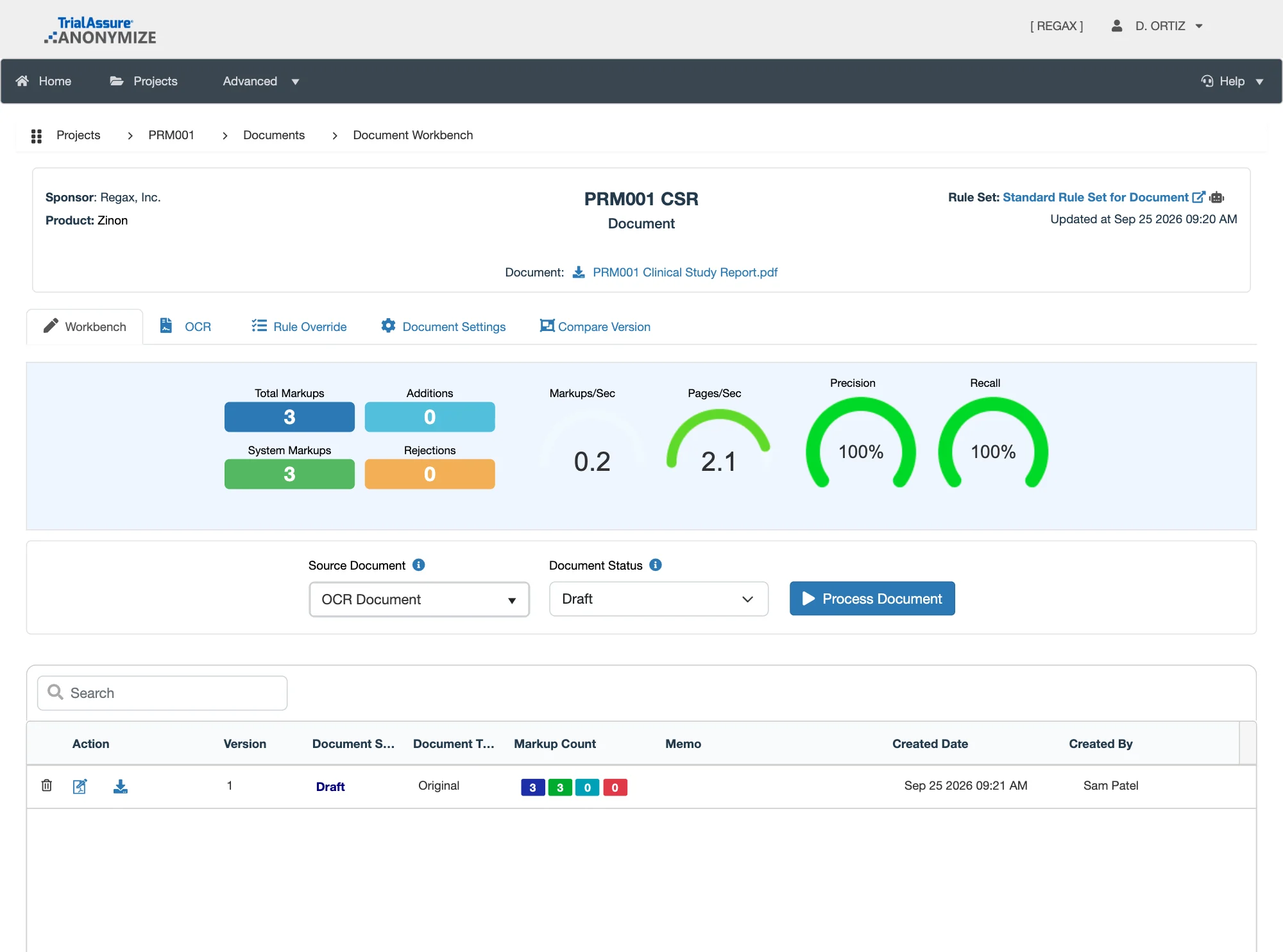
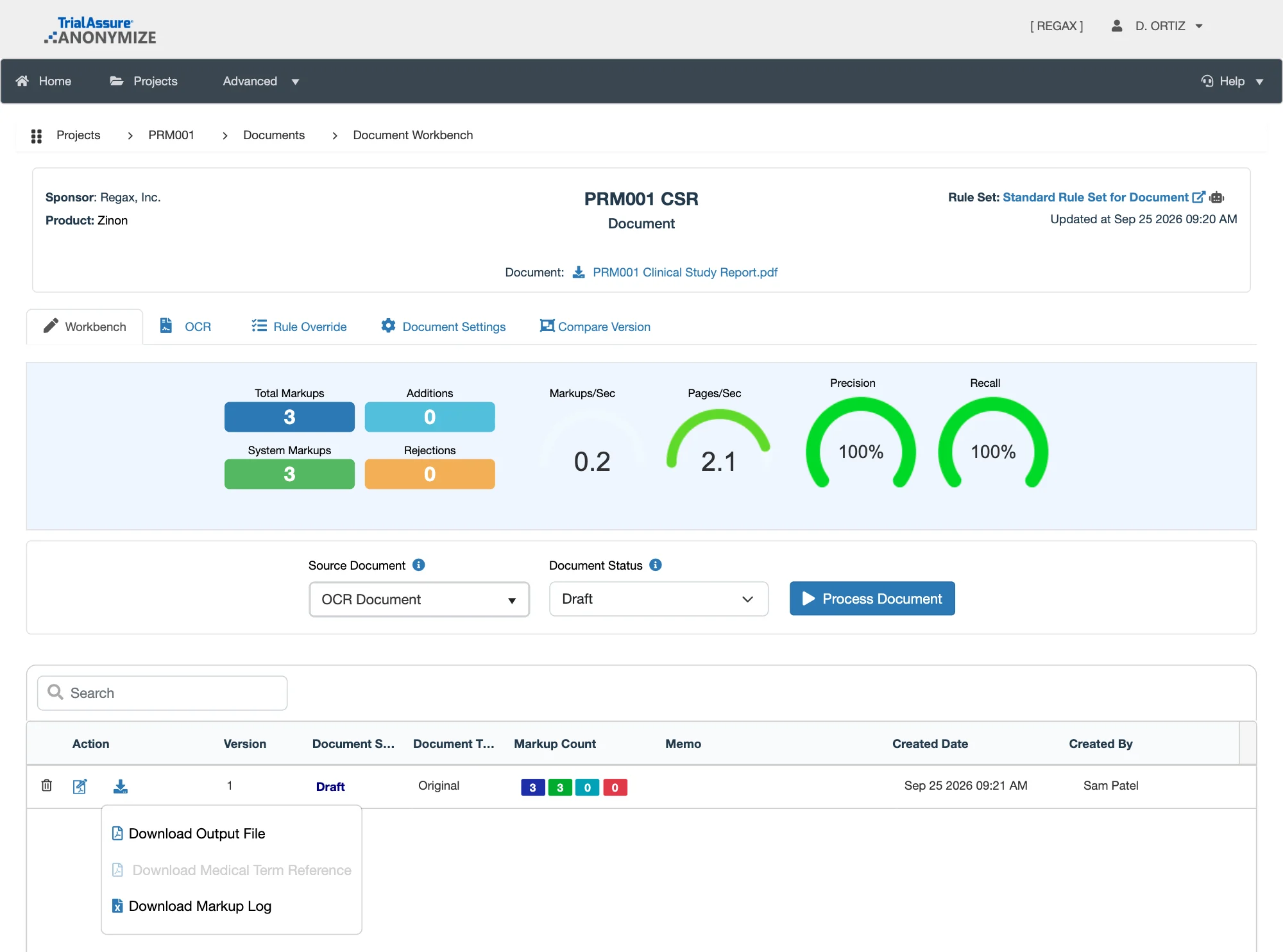
ANONYMIZE performs risk-based anonymization with quantitative risk scoring and generates the documentation behind your anonymization report. LINK AI accelerates the report drafting itself. The obligation is tracked alongside everything else you owe. And our EU entity, TrialAssure B.V., Eindhoven, means European delivery and European time-zone support. Perform it with technology, with our experts, or hand us the package.
EMA Policy 0070 — frequently asked questions
Who handles EMA Policy 0070 anonymization?
TrialAssure® delivers Policy 0070 anonymization three ways: as software your team runs (TrialAssure ANONYMIZE®), as an expert-run service where our specialists do the work, or fully outsourced. All three paths end in the same deliverables — risk-based anonymization of the clinical overview, clinical summaries and CSRs with their appendices, the anonymization report on EMA form EMA/482639/2023, and the CCI justification table. The sponsor stays the accountable party who signs and submits; every transformation is logged and attributable, so your methodology is defensible if EMA questions a choice. Compare the delivery models on services.
What is a Policy 0070 anonymisation report?
The Policy 0070 anonymisation report — as EMA spells it — is the document that explains how you anonymized the package: the methodology, the transformations applied to each identifier or quasi-identifier, and the residual re-identification risk left behind — submitted with your redacted documents on EMA form EMA/482639/2023. EMA publishes it alongside the clinical reports, so it is a public deliverable rather than an internal working file, and readers can judge whether your result sits under the 0.09 maximum re-identification risk reference threshold. ANONYMIZE generates the underlying evidence automatically — quantitative risk scores and transformation logs — and LINK AI speeds up drafting the narrative around it.
Does Policy 0070 require redaction, or anonymised data?
Both, for different content: Policy 0070 requires personal data to be anonymized and commercially confidential information to be redacted — and EMA judges the anonymised data on residual re-identification risk. EMA’s External Guidance favors risk-based anonymization — generalizing values, offsetting dates — over blacking text out, because a transformed document still supports secondary analysis. CCI is genuinely redacted, but each claim has to be justified line by line in EMA’s CCI justification table, and EMA assesses every one against its guidance. So redaction is the right tool only for CCI, and only where the justification holds: unjustified CCI redactions do not stand, and quantitative anonymization measured against the 0.09 risk threshold is the position that holds up.
When did Policy 0070 restart?
EMA resumed proactive publication of clinical data under Policy 0070 in September 2023, applying to CHMP opinions from that point on new active substances, and the first resumed packages appeared on clinicaldata.ema.europa.eu in January 2024. Publication had been suspended since December 2018 during EMA’s Brexit relocation, so teams that had a Policy 0070 process let it lapse — templates, risk-assessment methods and trained reviewers all need rebuilding before the next opinion lands. Scope then widened for applications submitted from April 2025 under EMA’s Step 2 model, so a paused process is now a live obligation on a short clock.
Can you handle the whole package for us?
Yes — at the fully outsourced end of the spectrum we prepare the redacted package, the anonymization report and the residual-risk assessment, then hand back submission-ready documents with the CCI justification table for your review and sign-off. Delivery comes from our U.S. team in Canton, Michigan and our EU entity, TrialAssure B.V. in Eindhoven — useful when the redaction-proposal window (up to 30 days after the CHMP opinion) runs on European working hours or your contracting has to sit with an EU entity. Specialists review every package before it leaves us: AI Enabled. Human Driven.™ You approve before anything reaches EMA. Start at contact.
Does EMA Policy 0070 apply to generics and biosimilars?
No — generic, hybrid, and biosimilar marketing authorisation applications are excluded from publication under Policy 0070. The Step 2 scope that took effect for submissions from April 2025 covers all other new initial MAAs, plus line extensions and major clinical Type II variations (extensions of indication) for centrally authorized medicines, and Step 1 (from September 2023) covers new active substances. If your product reaches the EMA through one of those routes, the anonymization obligation attaches.
What does EMA clinical data publication cover under Policy 0070?
EMA publishes the clinical overview (module 2.5), the clinical summaries (module 2.7), and each individual clinical study report with three appendices: the study protocol (and amendments), the sample case report form, and the documentation of statistical methods. Your anonymization report is published with the package. Individual patient data is not part of the current packages — EMA clinical data publication covers only these clinical reports, released on clinicaldata.ema.europa.eu after anonymization and CCI assessment.
How long do sponsors have to prepare a Policy 0070 package?
Up to 30 days from the CHMP opinion under the process in force since 2025 — with EMA targeting publication within 120 days of the opinion. Thirty days is not enough time to anonymize a full CSR package from a standing start, which is why teams begin risk assessment during the evaluation phase. TrialAssure ANONYMIZE handles the risk-based anonymization and LINK AI accelerates the anonymization report drafting, so the 30-day window is assembly, not creation.
What re-identification risk threshold does EMA expect for anonymization?
EMA’s External Guidance uses a maximum re-identification risk reference threshold of 0.09 (9%). The guidance favors quantitative, risk-based anonymization over qualitative redaction because it is measurable and preserves more data utility. Health Canada’s PRCI applies the same 0.09 threshold, so a quantified methodology — like the risk scoring in TrialAssure ANONYMIZE — carries across both jurisdictions with one defensible position.
Does Policy 0070 apply to withdrawn marketing authorisation applications?
Yes — withdrawing an application does not remove the publication obligation. Clinical reports from applications withdrawn before the CHMP opinion stage are published 150 days after the withdrawal request, and under the Step 2 process sponsors have up to 60 days from the withdrawal date to submit their redaction proposal package. New-active-substance applications withdrawn since September 2023 were among the first packages published when the policy resumed.
Have our specialists run your Policy 0070 anonymization
Tell us the shape of the work: how many CSRs and clinical summaries are in scope, whether the CHMP opinion has landed, and when your redaction proposal is due. We come back with who would run the risk-based anonymization, what the anonymisation report and CCI justification table take at that volume, and how soon we can start. A privacy specialist replies within one business day.



Get your Policy 0070 package ready
Trusted by 8 of the top 10 clinical development companies