Daiichi Sankyo · flagship
Daiichi Sankyo pairs LINK AI drafting with TrialAssure’s medical writers
- Up to 80%
- faster delivery
- ~50%
- lower cost/document


DRAFT & WRITE
TrialAssure LINK® AI helps medical writers — it doesn’t replace them. The AI medical writing software drafts clinical study reports, plain language summaries, and other regulatory documents inside Microsoft Word. Built around your source content, templates, and established writing practices, LINK AI accelerates regulatory medical writing while keeping experienced writers in control of the final document.
Who it is for
LINK AI works where medical writers already work, inside Microsoft Word and with the source documents that support their writing. Instead of asking writers to become AI experts, LINK AI puts purpose-built, patented technology behind the expertise they already bring to every document. A further patent is pending on how LINK AI drafts plain language summaries: it processes your source documents and uses templates, prompts and configuration to insert AI-generated text into the document, then shows it to your writers to review and edit.

Product tour
Six steps, no form: the document pipeline, per-field source citations, one-click publishing, and the public disclosure site’s own readership metrics. Simulated interface, fictional data.
Simulated product interface · fictional study data (“Zinon”, Regax Inc.)
| Delete | ID | Document Template | Study Title | Sponsor Name | Workflow Status | Publish Status | Created By | Version Date |
|---|---|---|---|---|---|---|---|---|
| 1 / 1 | Narratives | A study to investigate the efficacy and safety of Zinon delivered via hemodialysate in patients with chronic renal disease. | Regax, Inc. | Draft | Draft | M. Researcher | Aug 26 2026 07:12 AM | |
| 2 / 2 | Protocol | Registration record — physiological magnesium maintenance in chronic renal disease subjects requiring dialysis. | Regax, Inc. | Approved | Published | M. Researcher | Aug 13 2026 09:02 AM | |
| 1 / 1 | Narratives | Clinical study report summary for PRM001 — safety narratives and outcome overview. | Regax, Inc. | In Review | Draft | M. Researcher | Aug 24 2026 03:47 PM |
Official Title
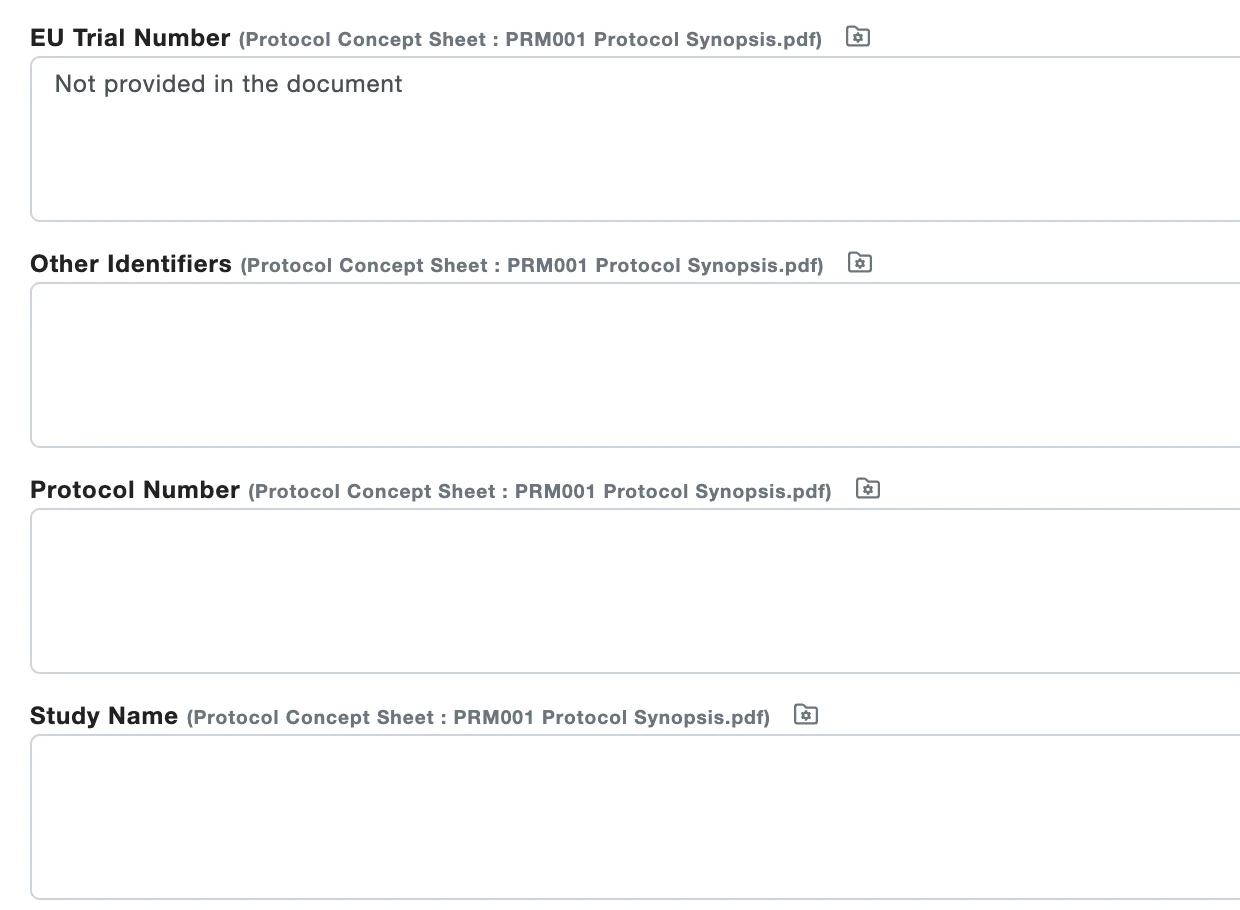
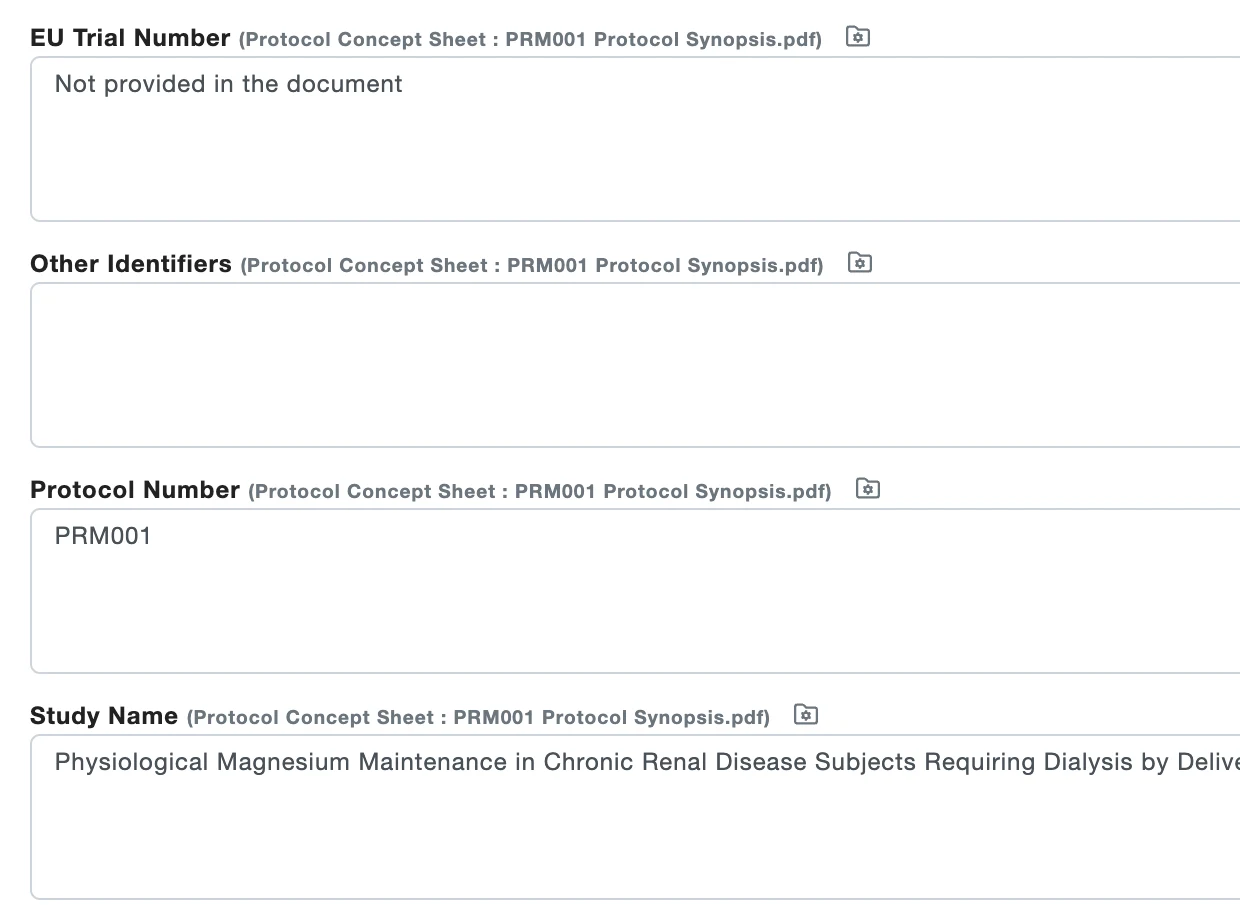
Physiological Magnesium Maintenance in Chronic Renal Disease Subjects Requiring Dialysis by Delivery of Zinon via Hemodialysate
Selected Sources : PRM001_Protocol_V3.docx
p. 1, title page · extracted Aug 24 2026
Title: Physiological Magnesium Maintenance in Chronic Renal Disease Subjects Requiring Dialysis by Delivery of Zinon via Hemodialysate
Brief Summary
The study looked at whether Zinon could keep magnesium at healthy levels in people with long-term kidney disease who need dialysis. Researchers also checked how safe Zinon was and how the body processed it during treatment.
Selected Sources : PRM001_Protocol_V3.docx
p. 14, §2.1 Objectives · extracted Aug 24 2026
Study Population
Adults with chronic renal disease receiving maintenance hemodialysis at least three times per week, enrolled across 14 sites.
Selected Sources : PRM001_Protocol_V3.docx
p. 22, §4.2 Eligibility · extracted Aug 24 2026
Primary Endpoint Result
Serum magnesium stayed within the target range for 84% of participants in the treatment group, compared with 41% receiving standard dialysate.
Selected Sources : PRM001_results.csv
sheet 1, row 4 · loaded Aug 25 2026
84%41%
The study looked at whether Zinon could keep magnesium at healthy levels in people with long-term kidney disease who need dialysis. Researchers also checked how safe Zinon was and how the body processed it during treatment. 1
Adults with chronic renal disease receiving maintenance hemodialysis at least three times per week, enrolled across 14 sites. 2
Serum magnesium stayed within the target range for 84% of participants in the treatment group, compared with 41% receiving standard dialysate. 3
| Study Title | ID | Sponsor Name | Publish Status | Publish |
|---|---|---|---|---|
| A study to investigate the efficacy and safety of Zinon delivered via hemodialysate in patients with chronic renal disease. | PRM001-PLS | Regax, Inc. | Draft | |
| Registration record — physiological magnesium maintenance in chronic renal disease subjects requiring dialysis. | PRM001-REG | Regax, Inc. | Published |
| Keyword | Count |
|---|---|
| zinon results | 214 |
| PRM001 | 126 |
| magnesium dialysis study | 78 |
| Sponsor | Count |
|---|---|
| Regax, Inc. | 301 |
| Country | Count |
|---|---|
| United States | 402 |
| Germany | 168 |
| United Kingdom | 121 |
Every disclosure document in one pipeline: template, workflow status and publish status in a single view. Open PRM001-PLS.
A clinical study report, for instance, can require 100s of hours of work, with writers gathering information from TLFs, SAPs, protocols, and previous CSRs before drafting and review even begin. Add growing clinical trial disclosure requirements and additional document types, and medical writing teams are being asked to produce more without sacrificing quality or oversight.
Writers gather and reconcile source information long before they begin applying their medical writing expertise.
Multiple reviewers, versions, and comments can turn reconciliation into a significant part of the document lifecycle.
Plain language summaries bring their own requirements, review process, and timelines alongside the core clinical documents.
More studies and document requirements put additional pressure on experienced medical writing teams.
Spend less time assembling. More time writing.
LINK AI takes on more of the assembly so medical writers can spend more of their time on the decisions, interpretation, and writing that require their expertise.
Start with your templates, document specifications, and style guidelines so LINK AI drafts to your organization’s standards and established writing practices.
LINK AI uses your approved source materials to generate clinical study reports, protocols, safety narratives, PLSs, ICFs, and other clinical documents directly in Microsoft Word.
Source-level traceability connects generated content back to the supporting document and passage, giving medical writers a clear path to verify where information came from.
Your medical writers, or TrialAssure’s regulatory writing services team, review, refine, and approve the content, with project management and traceability built into the process.
Built into the draft
Apply standardized glossaries to convert clinical terminology into reader-friendly language while maintaining consistency across documents.
Assess content against readability targets during drafting, giving writers another way to evaluate and refine their work.
Generate figures and charts from source data as part of the drafting process, keeping visuals connected to the underlying information.
Bring review into the same workflow, helping writers manage feedback, identify conflicting comments, and reduce the manual effort of reconciling multiple review copies.
Daiichi Sankyo runs plain language summaries on LINK AI
Document coverage
If your document is on this list, LINK AI drafts it today. If it is not, your template makes it one — templates, source types, and settings are fully customizable.
First drafts from your TLFs, SAP, and protocol.
Drafted from concept documents and prior studies.
Structured drafting from protocol and standards.
High-volume, consistent narratives from case data.
Lay summaries of trial results, written for participants.
Lay versions of papers and study protocols.
Readable, compliant consent drafting.
Custom templates produce any other document — clinical, technical, or plain-language.
First drafts from your TLFs, SAP, and protocol.
How it works →High-volume narratives, consistent quality.
See medical writing →See how one Japanese pharma engaged us.
Learn more →Certify your team on AI-assisted writing — four weeks, cohort-based, free of charge.
Get certified →Daiichi Sankyo · flagship
Watch

Draft clinical, regulatory, and plain-language documents in Microsoft Word
Cancer Research UK’s Centre for Drug Development uses LINK AI to draft regulatory and clinical trial documents — with its own medical writers central to every review.
Cancer Research UK’s Centre for Drug Development drafts with LINK AI
No unreviewed output, ever.
A qualified writer verifies, refines and signs off before anything is released.
TrialAssure LINK AI supports medical writers by taking on time-consuming drafting and assembly, with source-referenced content ready for expert review. Writers stay focused on interpretation, scientific judgment, and the quality of the final document. It’s a fresh, patented and patent-pending approach for scaling medical writing without diminishing the role of the writer.
Visit the Trust Center →Your writers, your templates, our purpose-built AI.
Get a demoAdd medical writing expertise and capacity when you need it.
Talk to our teamOur team drafts, verifies, and delivers with your oversight and approval.
Explore services


Clinical study reports built to ICH E3 structure, clinical study protocols, statistical analysis plans, patient safety narratives, informed consent forms, and plain language summaries — of results, publications, and protocols. Each type is drafted from source files you already have. For the CSR clinical trial teams file at study end, that means the protocol, SAP, and tables/listings/figures; narratives draw on case data. The list is not a fixed menu. If a document type is not on it, your template and prompt set make it one — sections, numbering and house style are configurable, so clinical, regulatory, technical and plain-language documents all run through the same drafting and source-referencing workflow. See medical writing for how teams sequence them.
Yes, natively. LINK AI is a Microsoft Word add-in, so drafting and refinement happen inside the same document your team already reviews and signs off in — track changes, comments, your styles and your numbering all intact. That matters beyond convenience: version history stays in one place for QC and regulatory reviewers, and nobody has to reformat a draft after moving it between tools. There is no second application for writers to learn, and finished drafts land in the repositories you already use, including OpenText.
With regulatory document drafting AI, a human writer — not the model — is accountable for what ships. Drafted statements are referenced to the source material they came from, so review is verification against a citation rather than a judgment call. Every edit is logged and attributable, which gives you a change history you can show an auditor or inspector. A qualified writer verifies, refines and signs off before anything is released — “AI Enabled. Human Driven.™” is the operating rule, not a slogan. Clinical study report automation accelerates assembly; the model never holds sign-off authority.
No. LINK AI runs in a secured, closed architecture hosted on Azure: your documents and source data are used to draft your documents and nothing else. Client data is not used to train public models and is never shared between customers, and content is encrypted in transit and at rest. TrialAssure is ISO/IEC 27001:2022 certified by Intertek under UKAS accreditation and ISO 9001:2015 certified, GDPR-aligned with an EU contracting entity in Eindhoven, and a data processing agreement is available. Full detail sits in the Trust Center.
Then use ours. TrialAssure offers regulatory writing services on the same platform, so you can license LINK AI for your own writers, co-write with ours under your oversight and sign-off, or hand us the document list and receive verified drafts. Daiichi Sankyo runs plain language summaries that way — up to 80% faster delivery at ~50% lower cost per document, with the partnership renewed. Your team keeps approval authority in every model; what changes is only how much of the assembly work sits with us. See services or the case study.
Yes. AIMWC — TrialAssure’s AI-for-Medical-Writing Certification — is four live sessions that certify your writers on AI-assisted drafting, provided free of charge. It is cohort-based, and it teaches how to prompt, refine and critically review AI-drafted clinical and plain-language content, including where a writer has to intervene, so the certificate is about editorial judgment rather than tool clicks. It is open to your team whether or not you license LINK AI — the frameworks transfer to any AI writing stack. Configuration on your own templates and document types is handled separately, when we set LINK AI up with you. See AIMWC certification.
30+ countries now require every clinical investigation to include a lay summary of trial methods and results — and the list keeps growing. In the EU, the Clinical Trials Regulation makes a plain language summary part of the results a sponsor posts to CTIS, not an optional courtesy, and it is owed in the local languages of the countries where the trial ran. So a single study can generate a set of summaries rather than one document, on a clock that runs independently of the CSR. See plain language summaries.
Yes. Refinement is part of drafting rather than a separate step: a writer selects a section, prompts it in plain language — tighten this, use a different source table, make this readable for a patient audience — and reviews the revision before it enters the document. Because each section is generated against your template and its own source files, one section can be reworked without disturbing the rest of the draft. Nothing is applied silently: the writer chooses what to insert, and track changes records it like any other edit.
Every generated section carries references: drill down and LINK AI shows which source document — and which passage in it — was used to write that section, including which table a figure was pulled from. If it used the wrong table, point it at the right one and regenerate. That per-section traceability is what generic AI tools can’t give you without a chain of “where did you get this?” prompts.
No — LINK AI ships as a Microsoft Word add-in. Writers open the drafted document in Word, see the prompt and response behind each section in a side panel, refine in a chat-style exchange (“shorten this,” “use the week-12 table”), and insert the result. Track changes, your templates, your styles — nothing leaves the writer’s normal environment.
Yours. Upload your company templates — sections, numbering, house style — and LINK AI populates them from your source files (protocol, SAP, tables/listings/figures). The template defines the shape of the document and the prompts define what each section has to say, so a draft arrives in your format instead of a generic one a writer then rebuilds. New document types need a new template and prompt set, not new software; the platform is not hard-coded to any one format. Templates and settings are configured with you during implementation.
LINK AI integrates with OpenText, and drafting happens natively in Microsoft Word — so drafts live in the tools and repositories your writers already use. A document pulled from your system into Word stays an ordinary Word file; the add-in adds drafting and source references rather than a parallel place to store documents. We name only the integration we have, OpenText. If you run something else, the practical question is how your writers get documents into and out of Word, and that is worth scoping against your environment during the demo.
Bring one source package — protocol, SAP, and tables — and we will draft from it live, so you are judging a first draft of your own study rather than a sample. A medical writer replies within one business day.