Daiichi Sankyo · flagship
Daiichi Sankyo pairs LINK AI drafting with TrialAssure’s medical writers
- Up to 80%
- faster delivery
- ~50%
- lower cost/document

TrialAssure LINK® AI gives medical writing teams a purpose-built way to increase capacity across clinical and regulatory documents. Draft inside Microsoft Word in just days (not weeks!) using your templates and source materials, with content referenced back to source and experienced writers in control of the final document.
For medical writing teams
The medical writing clinical trials generate keeps growing — every study needs a CSR, narratives, a protocol and a plain language summary — and the headcount to write it all has not moved. TrialAssure LINK AI drafts inside Word from your own source documents, with every claim traceable, allowing your writers to begin with a review rather than start from nothing. When the pipeline outruns the team, our medical writing services team can pick up the overflow on the same platform.
THE WRITER’S REALITY
First drafts in days. Clinical study report writing time reduced approx. 90% for one top-10 pharma engagement.
The exact workflow that one Sponsor runs at up to 80% faster, and ~50% lower cost per document.
Generated content is referenced to source, so quality control is a check, not a search.
LINK AI adds drafting capacity without adding headcount. Writers stay central; the mechanical layer goes to the machine.
Writers decide and sign off by design, and free AIMWC certification trains them on responsible, defensible AI use.
Templates, terminology, and document specifications help keep CSRs, narratives, plain language summaries, and other regulatory documents consistent.
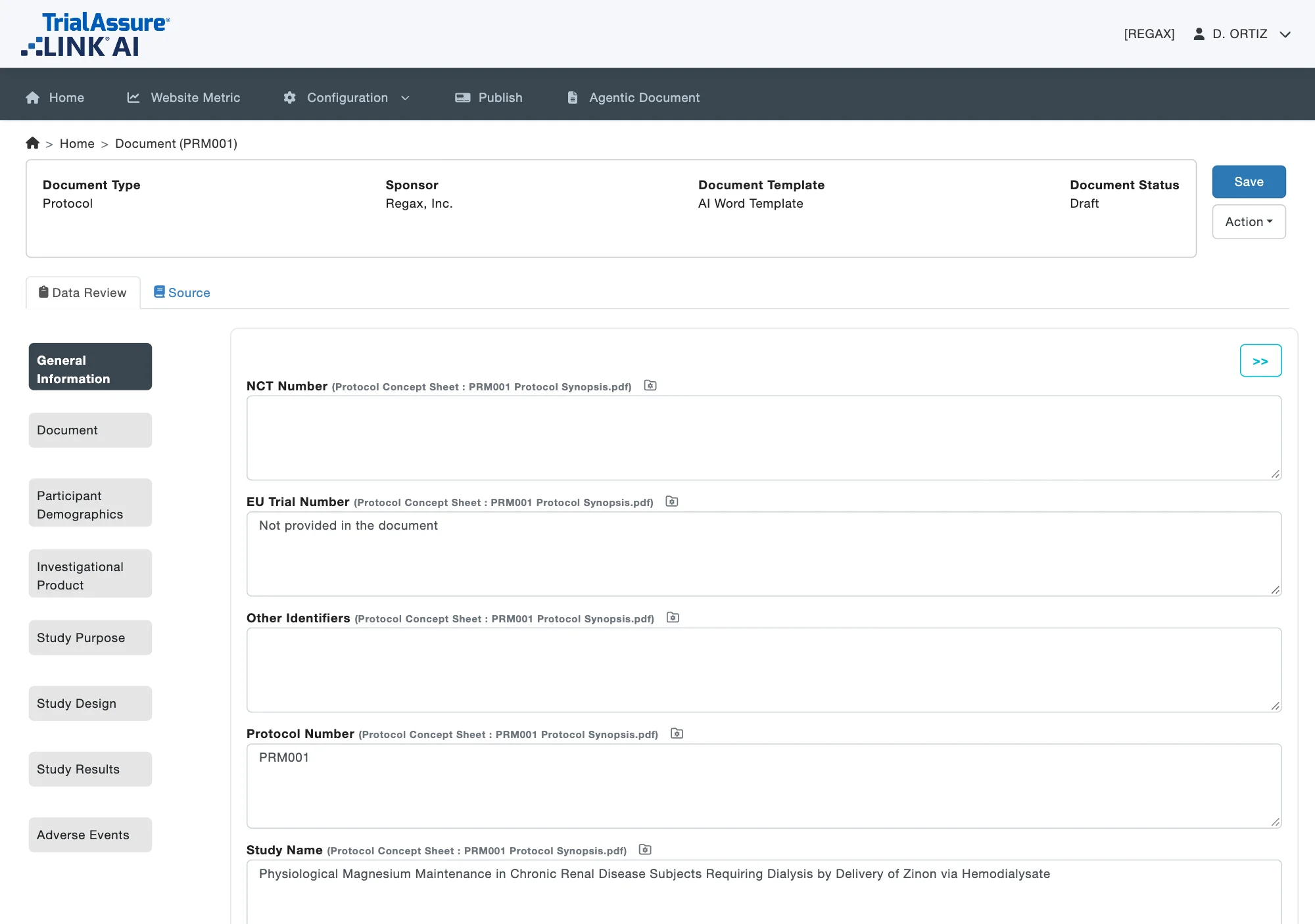
Give TrialAssure LINK AI your source documents and your template or house style — TransCelerate, CDISC, or your own specifications. It works inside Word, where your writers already work.
A structured draft is created using your established conventions, with generated content linked back to supporting source material so writers can quickly verify where information came from.
Your writer applies scientific judgment, refines the content, and makes the final decisions. LINK AI supports the writing process with experienced medical writers remaining in control.
Drafting, review, and approval activity is captured in a time-stamped audit trail, giving teams a traceable record throughout the document lifecycle.
License TrialAssure LINK AI, work alongside our medical writers, or hand the backlog to our regulatory medical writing services when additional capacity is needed. The same technology supports each approach.
| Capability | LINK AI (TrialAssure) | Generic AI writing tools | Outsourced medical writing company |
|---|---|---|---|
| Where you work | Inside Microsoft Word, on your templates | Separate chat window, generic output | Offsite; you receive finished drafts |
| Source referencing | Claims referenced back to source | Invents plausible citations | Varies by vendor QC |
| Regulatory context | Built for CSRs, narratives, PLS, ICFs, protocols | No clinical or regulatory context | Strong, but tied to writer availability |
| Your data | Never used to train public models | May be used for model training | Leaves your environment |
| Institutional knowledge | Stays with your writers | None retained | Walks out with the vendor |
| Speed and cost | Up to 80% faster, ~50% lower cost/doc on PLS (Daiichi Sankyo) | Fast but unreliable; needs full rewrite | Slow; premium pricing |
| Accountability | Your writer signs off; full audit trail | No audit trail | Shared or unclear ownership |
Daiichi Sankyo · flagship
Cancer Research UK’s Centre for Drug Development uses LINK AI to draft regulatory and clinical trial documents — with its own medical writers central to every review.
Start where you are and change the mix as your pipeline shifts, from licensing the software to using us as your medical writing company — the same LINK AI platform runs across all three.
Your writers, our technology, inside Word.
Get a demoShared workload, your sign-off.
Talk to our teamOur team manages the work with your oversight and approval.
Explore servicesCSRs, patient safety narratives, protocols, plain language summaries, ICFs, and more, drafted in Word and referenced back to source.
See LINK AI →Build practical AI skills across your medical writing team with free, four-week, cohort-based certification.
Get certified →Support plain language summary drafting for EU CTR requirements, with source-referenced content ready for medical writer review.
See PLS →Co-write with our medical writers, or hand us the backlog — using the same platform that your team uses.
Explore services →No. TrialAssure LINK® AI supports writers rather than replacing them — it produces the first draft, your writers make the judgment calls and sign off, and the audit trail records who did what. It gives writers back the hours that mechanical drafting used to consume, so their capacity moves to the interpretation and argument only they can do.
Fully. LINK AI builds from industry templates like TransCelerate and CDISC or from your own document specifications — section order, numbering, terminology, table conventions, and styling. The specification is supplied once and applied across the whole document family, so a CSR, its patient safety narratives, and its plain language summary stay consistent instead of drifting between authors. Drafts arrive in your house style rather than a generic shape you would have to rebuild. Where a house convention is undocumented or ambiguous, your writers settle it in review — the template governs structure and format, never scientific judgment.
Yes. LINK AI runs as an assistant inside Microsoft Word, so writers draft, review, and edit in the workspace and file formats they already use. You point it at your source content and your template, drafted statements carry their source references alongside the text, and tracked changes and comments behave exactly as your reviewers expect. There is no separate application to learn, no copy-paste between tools, and no export step that could strip formatting or break numbering. The file your writer signs off on is the file the AI drafted into.
LINK AI drafts only from the source content you give it, and links every statement back to where it came from. General-purpose chatbots invent plausible-looking citations because they are predicting text, not reading your data; LINK AI is constrained to the source documents you supply, and each drafted statement carries the reference it was built from. A reviewer can follow any claim to its source, so quality control becomes a check against source rather than a hunt for it. Judging whether a referenced statement is the right one to make stays with your writer.
No. LINK AI runs in a closed architecture: the source content you provide is used only to draft your documents, never to train public models and never shared with other customers. The platform is Azure-hosted, with encryption in transit and at rest. TrialAssure is ISO/IEC 27001:2022 certified by Intertek under UKAS accreditation, certificate 0251375, and ISO 9001:2015 certified for quality management. Handling is GDPR-aligned and HIPAA-aligned, TrialAssure B.V. in Eindhoven is available as the EU contracting entity, and a DPA is available. The full security posture and certifications are documented in the Trust Center.
The core regulatory and scientific set: clinical study reports, patient safety narratives, study protocols, plain language summaries, and informed consent forms. Each is drafted from the source content you supply and shaped by your template for that document type, so one tool covers the medical writing clinical trials require, instead of every document needing its own setup. Patient-facing documents like plain language summaries run through the same source-referenced workflow as the regulatory ones, which is what keeps a summary faithful to the report behind it. Documents with no clinical source to draft from sit outside the intended scope.
With medical writing AI in the workflow, CSR drafting hours were cut ~90% at a top-10 pharma, against the 280 hours a manual CSR assembly typically takes, and Daiichi Sankyo delivers plain language summaries up to 80% faster at ~50% lower cost per document. The exact gain depends on document type, source quality, and how much review your SOPs require. The saving comes from mechanical work: pulling numbers from tables, stitching sections, formatting to template. Review time does not disappear — writers still read, judge, and sign off — so expect a shorter drafting phase, not a uniformly shorter process. See the AI-augmented CSR case study for the workflow in detail.
Accountability stays human. AI drafts, but your writer edits, decides, and signs off, and every change is captured on a time-stamped audit trail with attributable authorship — who drafted, who edited, who approved, and when. Part 11 expects records to be attributable, traceable, and reviewable; ICH E6(R3) places responsibility for trial quality on the sponsor rather than on a tool. LINK AI is built around both: the human remains the author of record, and the evidence of that lives in the document rather than in someone’s recollection. Validation and your own SOPs remain yours to own — we supply the traceability they rely on.
A medical writing agency is capable but tied to writer availability, carries premium pricing, and takes institutional knowledge offsite. LINK AI keeps drafting — and the knowledge behind it — with your own team, adding capacity without adding headcount. You can also blend the two: license the software, co-write with our writers, or hand us the backlog.
Through AIMWC, our free AI in Medical Writing Certification. It runs four weeks, cohort-based, with four live weekly 60-minute sessions plus on-demand replays, covering human oversight, QA against source, prompting, and where a judgment call should never be delegated to a model. It is written for practicing medical writers and their managers rather than for IT, and it is deliberately not a product course — the practices transfer whatever tooling a team ends up using. Certifying the team matters because the compliance model puts the writer, not the software, in the accountable seat.
Yes. Beyond licensing the software, we offer professional medical writing services: our writers co-write alongside your team or take a backlog end to end — the same model Daiichi Sankyo runs — all on the same LINK AI platform, so templates, drafts, and audit trail stay consistent whoever is holding the pen. Sponsor sign-off remains yours in every arrangement; we never become the author of record. You can also move between the three as the pipeline shifts: license during steady state, co-write through a submission peak, hand over the backlog when volume outruns headcount. Explore the options under medical writing services.
TrialAssure LINK AI drafts regulatory and scientific documents, including CSRs, patient safety narratives, protocols, plain language summaries, and ICFs, inside Microsoft Word, on your own templates and source materials. Generated content is referenced back to source, giving medical writers a clear path to verify, edit, and approve the final document.
Regulatory writing volume continues to grow every year across plain language summaries, narratives, CSRs, and other clinical documents. TrialAssure LINK AI helps teams expand their capacity by drafting inside Microsoft Word, on your own document specifications, templates, and source materials, with all generated content referenced back to its source. Medical writers remain in control of the final document.
One tool covers the regulatory document set, including clinical study reports, patient safety narratives, study protocols, plain language summaries, and informed consent forms. TrialAssure LINK AI builds from industry templates like TransCelerate and CDISC or from your style guide, so drafts follow your established conventions rather than requiring your team to rework a generic starting point. See LINK AI by document type to explore how each fits your workflow.
TrialAssure LINK AI drafts from the source content you provide and links generated content back to the supporting source, giving medical writers a clear path to verify information during review. That traceability helps teams use AI-assisted drafting within regulated medical writing workflows while keeping review, scientific judgment, and final approval with experienced professionals.
LINK AI runs in a closed architecture. The source content that you provide is used only to draft your documents. It is never used to train public models or exposed to other customers. Medical writers remain responsible for review, decisions, and final approval, with activity captured in a time-stamped audit trail. The full security posture and certifications are documented in the Trust Center.
Adopting AI responsibly is its own skill. Our free AIMWC certification trains your medical writers on AI oversight, quality assurance, and prompting through a four-week, cohort-based program. When volume spikes, TrialAssure’s medical writing team can work alongside yours or take on the writing using the same platform that your team uses.
Tell us what's in the queue — CSRs, patient safety narratives, protocols, plain language summaries, ICFs — how many, and when they're due. We'll come back with who would write them, how the work splits between your team and ours, and how soon we can start: co-writing through a submission peak, or taking the backlog end to end. A medical writer replies within one business day.
AI Enabled. Human Driven.™ Your writers stay accountable — always.