License REGISTRY
Your disclosure team, our technology.
Get a demo

REGISTER & DISCLOSE
TrialAssure REGISTRY® brings global clinical trial registration and results disclosure into a single platform, supporting ClinicalTrials.gov, CTIS, and 40+ registries worldwide with their distinct requirements, formats, and deadlines. The result is Compliance with Confidence™, with greater visibility into what is required, what is due, and what needs attention.
Who it is for
Disclosure teams manage obligations across studies, countries, and registries, with requirements and deadlines that can quickly become difficult to track. TrialAssure REGISTRY brings those obligations into one system, giving teams greater visibility into what is required, what is due, and what needs attention.

Product tour
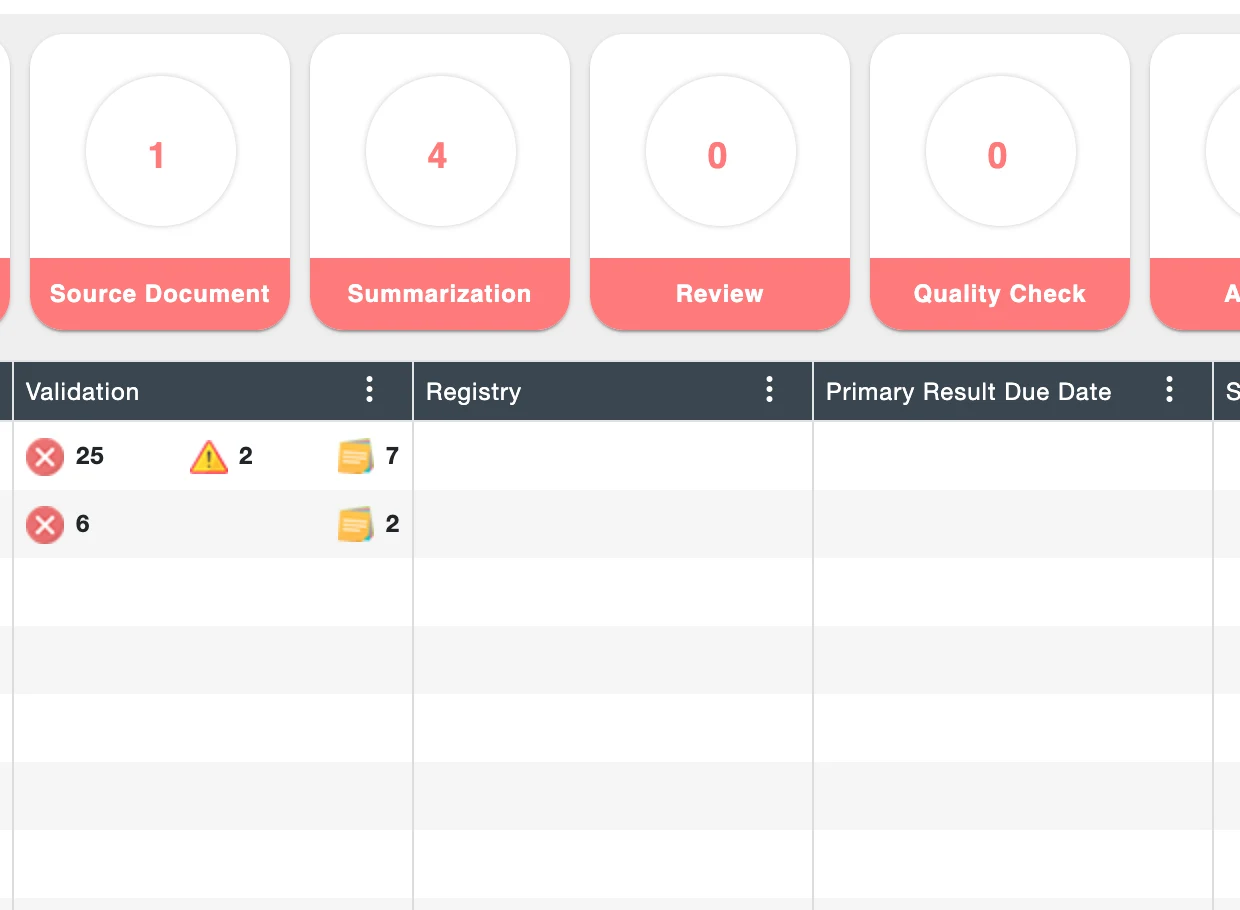
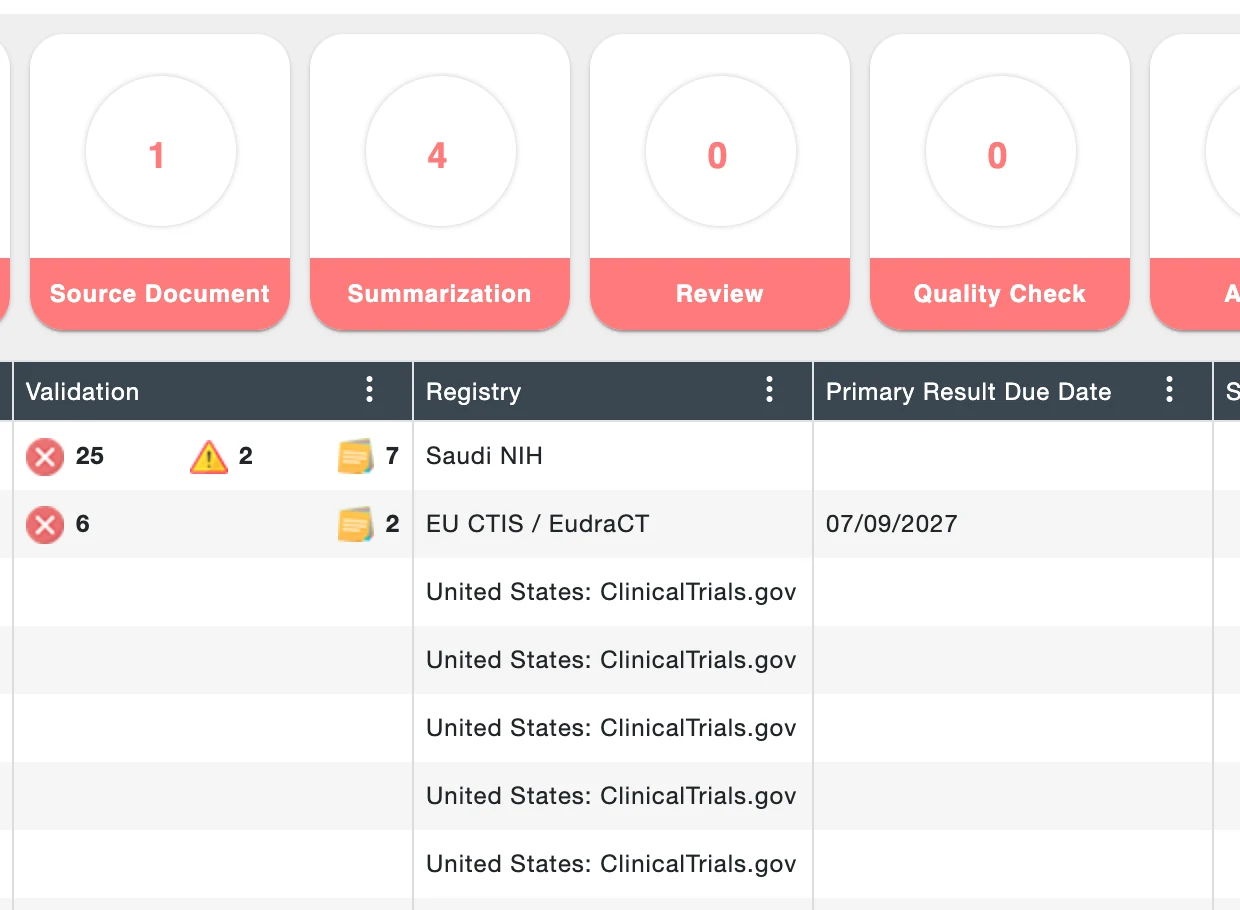
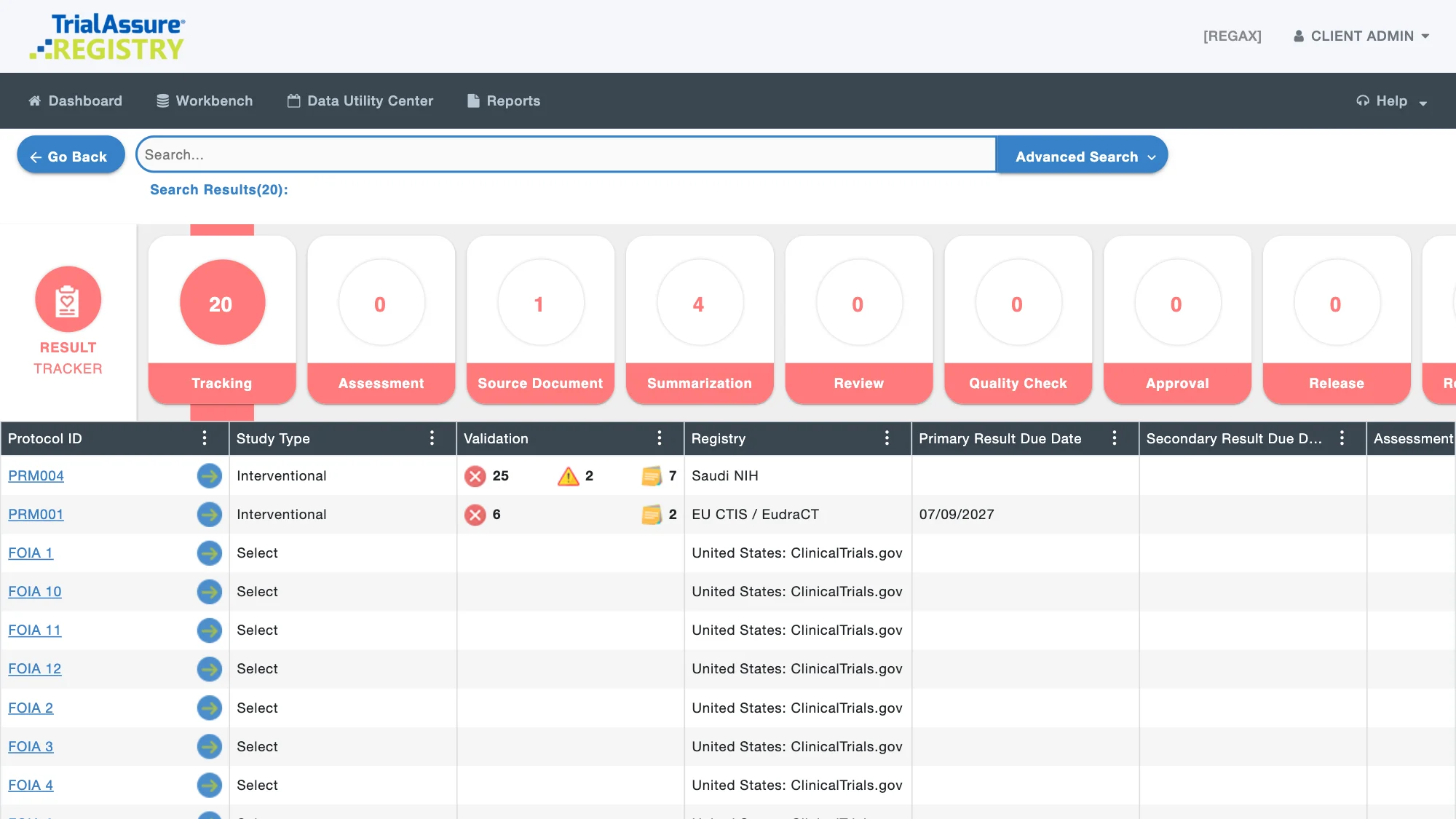
Six steps, no form: the portfolio dashboard, the Workbench, due dates worked out from one record, validations, and release. Simulated interface, fictional data.

Simulated product interface · fictional study data (“Zinon”, Regax Inc.)
| Protocol ID | Study Type | Validation | Registry | Primary Result Due Date | Workflow Step |
|---|---|---|---|---|---|
| Interventional | 41 | EU CTIS / EudraCT | Tracking | ||
| PRM002 | Interventional | 12 | United States: ClinicalTrials.gov | 11/03/2026 | Summarization |
| PRM003 | Observational | 2 | United States: ClinicalTrials.gov | 01/22/2027 | Assessment |
| PRM004 | Interventional | 3 | EU CTIS / EudraCT | 03/18/2027 | Summarization |
| PRM005 | Interventional | 12 | Japan: jRCT | 05/06/2027 | Review |
| PRM006 | Expanded Access | United States: ClinicalTrials.gov | Approval |
| Registry | Obligation | Rule | Due Date |
|---|---|---|---|
| ClinicalTrials.gov | Registration | Study Start Date + 21 days | 02/10/2025Calculated |
| EU CTIS | End-of-trial notification | End of Trial + 15 days | 06/29/2026Calculated |
| EU CTIS | Summary of results | End of Trial + 1 year | 06/14/2027Calculated |
| Section Type | Section | Field | Type | Message |
|---|---|---|---|---|
| Protocol | Oversight | Board Name | Error | Board Name: data not entered. |
| Protocol | Oversight | Board Contact | Error | Neither Board Phone nor Email was entered. |
| Protocol | Summary / Description | Brief Summary | Error | Brief Summary is a required field. |
| Result | Outcome Measure | Error | Outcome Measure Data is required for at least one primary outcome measure. | |
| Protocol | Oversight | Data Monitoring Committee | Note | Data Monitoring Committee?: data not entered. |
Every study in every registry, sorted by what needs attention: missed due dates, late workflow steps, on track. Open the Workbench.
FDAAA 801 sets specific timelines for registration and results reporting, but those requirements are only one part of a global disclosure program. Across 40+ registries and jurisdictions, teams must account for different fields, formats, deadlines, and update requirements. REGISTRY brings those obligations together so teams can manage compliance with greater visibility and confidence.
Fields, formats, and validation requirements differ across registries, creating additional work when preparing and maintaining submissions.
What needs to be updated and when can depend on the registry, jurisdiction, and study status.
Registration, authorization, study completion, and other milestones can trigger different disclosure obligations and timelines.
Spreadsheets and disconnected processes make global obligations harder to see and manage. REGISTRY gives teams one place to track requirements, responsibilities, and deadlines.
Study data enters once, directly or through your CTMS.
The rules engine applies study information to identify registry-specific requirements and deadlines.
Prepare and manage registrations, updates, and results postings from one queue.
Every submission, timestamp, and change is logged to support compliance and audit readiness.
Under the hood
AI reads your protocol and identifies relevant trial information to help prepare registration data, reducing manual entry and giving your team a stronger starting point.
Track every study through registry assessment, validation, quality checks, review cycles, approvals, and regulatory authority comments in one view.
Manage registration, updates, and results disclosure within the same platform, keeping study information connected throughout the process.
Watch

Technology to simplify clinical trial registration and results disclosure
Global disclosure technology backed by 15+ years of regulatory expertise.
TrialAssure REGISTRY’s rules engine is maintained against current regulatory requirements, helping your team stay on top of changes without relying on outdated manual tracking. When requirements call for interpretation, disclosure experts remain part of the process.
Visit the Trust Center →Your disclosure team, our technology.
Get a demoAdd expertise and capacity when you need it.
Talk to our teamFull-service clinical trial registration and results disclosure.
Explore servicesIt manages registration and results disclosure for a whole portfolio from one system. Study data enters once, a rules engine translates each study’s scope into the requirements and deadlines of every registry it is subject to, submissions and updates are prepared from a single queue, and each submission, timestamp and change is logged as compliance evidence.
Global disclosure requirements vary across registries, including fields, formats, validation rules, update requirements, and deadlines. REGISTRY brings those differences into one place, giving teams a clear view of obligations across their portfolio and reducing the manual tracking needed to stay current.
When registry requirements change, REGISTRY’s rules engine is updated centrally and affected studies can be reassessed against the new requirements. Your team gets greater visibility into what changed and where action may be needed without manually retracing every study.
TrialAssure REGISTRY can stand on its own or connect with other TrialAssure products when needed. And when your team needs additional support, TrialAssure’s disclosure experts can work alongside you or manage registration and results disclosure on your behalf.



REGISTRY covers 40+ registries globally, including ClinicalTrials.gov and EU CTIS, with the full list available on request. Each clinical trial registry is treated as its own ruleset rather than one generic form: distinct data fields, validation rules, update triggers, and clocks that start from different events — first participant enrollment at one registry, authorization or completion at another. The rules engine is updated as registries change their requirements, so each submission is prepared against that registry’s current ruleset rather than a generic internal checklist. Coverage is registration, updates and results posting — not scientific review of the content you submit.
FDAAA 801 requires registration within 21 days of first participant enrollment and results within 12 months of primary completion, all filed through the ClinicalTrials.gov PRS. REGISTRY tracks both clocks per study automatically, derived from the study record rather than a manually maintained calendar, and surfaces studies approaching a date instead of reporting the miss afterwards. The penalty math is why this matters: U.S. fines now run up to $15,107 per day. Deadlines are not always fixed — the regulation allows certified delays for some results submissions — so the engine tracks the date that actually applies to each study and leaves the filing judgment to your disclosure specialists.
Yes — study information flows in from your CTMS or data warehouse via API, and deadline-driven workflows flow back out, so you enter data once instead of re-keying it across systems. Field mapping is configured to your data, which means the rules engine reads the same study record your operations team already maintains — identifiers, sites, enrollment events, completion dates — and derives per-registry requirements from it. Where no integration exists, studies can be entered directly in the portal instead. Either way, every submission, timestamp and change is logged, so the audit trail survives the handoff between systems.
Yes — REGISTRY handles EU CTR requirements through CTIS, including the transparency rules and results timelines. EU CTR trials sit alongside your other registries, so the application, substantial modifications and results postings share one queue with their deadlines visible. CTIS is unusual in that publication is part of the submission: what becomes public, and when, depends on the trial category and the deferral rules that apply to it, so the answer is a per-trial determination rather than a single date. See the EU CTR / CTIS requirement page for the full mapping.
The rules engine is updated centrally. Your open studies re-evaluate against the new requirement — no spreadsheet archaeology. You do not maintain your own copy of the regulation, reissue an SOP, or rediscover by hand which studies were affected: the change lands once, and the deadlines and required fields across your portfolio move with it. The engine is maintained against current regulation, and TrialAssure publishes Registry Snapshots tracking global requirements. Where a change alters what you must disclose rather than only when, REGISTRY flags the affected studies and disclosure specialists review the edge cases so your team makes the call.
Yes. Results prepared in REGISTRY hand off to TrialAssure ANONYMIZE for defensible de-identification, so registration, anonymization, and disclosure run as one workflow instead of three disconnected ones. Nothing is re-keyed between them: the study record, the document set and the disclosure deadline carry across, and the anonymization decisions — what was redacted or transformed, under which rule, reviewed by whom — are logged against the submission they support. That is what you need years later, when a regulator questions a redaction and the specialist who made the call has moved on.
Yes — REGISTRY is the platform we customize. Registry requirements differ by country and agency, and the engine was built for that variance: organizations have engaged us to configure it per registry, extend it with AI-assisted protocol-field extraction, and build branded clinical trial registry platforms on it as a base. If your requirement goes beyond the product, talk to us.
Bring one study and the registries it has to reach. We will map the obligations it creates and show you the deadlines REGISTRY would already be tracking. A disclosure specialist replies within one business day.