FDAAA 801 & ClinicalTrials.gov
Register within 21 days of first participant. Post results within a year of primary completion. The FDA is actively contacting responsible parties about missing results.
Last verified October 2026 against primary sources.
At a glance
- Authority
- FDA (enforcement); NIH/National Library of Medicine (operates ClinicalTrials.gov)
- Legal basis
- FDAAA §801, Pub. L. 110-85 (2007); PHS Act §402(j), 42 U.S.C. 282(j); implementing regulation 42 CFR Part 11 (81 FR 64982, Sept 21, 2016)
- Applies to
- “Applicable clinical trials” of FDA-regulated drugs, biologics, and devices with a US nexus — Phase 1 drug trials and small feasibility device studies excluded
- Registration trigger
- First participant enrolled — ClinicalTrials.gov registration due within 21 calendar days (42 CFR 11.24(a))
- Results deadline
- 12 months after the primary completion date; certification for unapproved products can delay up to 2 years (42 CFR 11.44)
- Penalties
- Up to $15,107 per day uncorrected after a 30-day notice (21 U.S.C. 333(f)(3)(B); 2025-adjusted level published Jan 28, 2026 and still current — OMB canceled the 2026 inflation adjustment)
- Enforcement to date
- 246 Preliminary Notices posted (through FDA’s June 2026 update), 8 Notices of Noncompliance since 2021, 0 civil money penalties assessed
- Status & key dates
- In force — compliance required since April 18, 2017; escalating enforcement: FDA contacted 2,200+ sponsors about missing results on March 30, 2026
Who this is for
The person answering for ClinicalTrials.gov registration status.
FDAAA 801 penalties follow missed deadlines, not bad intentions. Validation against ClinicalTrials.gov requirements happens before submission rather than arriving as an agency query.
Deadlines that matter
| Event | Deadline | Notes |
|---|---|---|
| ClinicalTrials.gov registration | Within 21 calendar days of enrolling the first participant | 42 CFR 11.24(a). The clock starts the day the first participant enrolls — not the day the registry team hears about it. |
| Standard results submission | Within 12 months of the primary completion date | 42 CFR 11.44(a). Structured tables: participant flow, baseline, outcome measures, adverse events. NLM quality-control review follows submission and can send the record back. |
| Delayed results via certification (unapproved product or unapproved new use) | Earlier of: 2 years after the certification date, or 30 calendar days after FDA approval, licensure, or clearance | 42 CFR 11.44(b)-(c). Only one certification permitted per trial; it must be submitted before the standard 12-month deadline expires. |
| Good cause extension request | Before the results due date | 42 CFR 11.44(e). NIH grants or denies; if granted, a new submission deadline is set. |
| Record updates | At least once every 12 months | 42 CFR 11.64. Certain changes (e.g., recruitment status, primary completion date) must be updated on shorter timelines. |
| Correction after FDA Pre-Notice | 30 days after receiving the Preliminary Notice of Noncompliance | Voluntary correction window. Failure to address it can trigger a formal Notice of Noncompliance. |
| Correction after Notice of Noncompliance | 30 calendar days after receipt | After this window, civil money penalties of up to $15,107 per day may be assessed under 21 U.S.C. 333(f)(3)(B), plus possible injunction or criminal prosecution. |
Regulatory guidance changes. Deadlines and requirements shown here are a summary, not legal advice — confirm them against the current text published by the relevant authority before you rely on them for a submission.
ClinicalTrials.gov results reporting: when are results due?
- Results submission due on ClinicalTrials.gov Standard deadline, with specified mechanisms for delayed submission or extension +12 months
Informational only — confirm against the regulation and your regulatory counsel.
Don’t let these dates slip. We’ll email them to you with a calendar file that reminds you 90, 30 and 7 days before each one.
Regulatory guidance changes. Deadlines and requirements shown here are a summary, not legal advice — confirm them against the current text published by the relevant authority before you rely on them for a submission.
The ClinicalTrials.gov registration workflow
-
Make and document the ACT determination.
Evaluate every interventional study against 42 CFR 11.22: FDA-regulated drug, biologic, or device; not Phase 1 or a small feasibility study; US site, IND/IDE, or US-manufactured exported product. Record the rationale — the first question in any Pre-Notice response is why you concluded what you concluded.
-
Wire the 21-day clock to first participant in.
ClinicalTrials.gov registration is due 21 calendar days after first enrollment, and registry teams routinely learn of FPI late. Feed the trigger from CTMS enrollment events, not monthly status calls.
-
Decide the results pathway before primary completion.
The 12-month clock starts at the primary completion date. Decide in advance whether standard submission, a delayed-submission certification, or a good-cause extension applies, and address any certification or extension requirements before the applicable deadline.
-
Budget for the results build and NLM QC review.
ClinicalTrials.gov results are mostly structured data tables, plus the protocol and statistical analysis plan, and NLM’s quality-control review returns records for correction. FDA’s March 2026 outreach specifically flagged sponsors that had not completed QC review.
-
Update annually and keep the evidence.
Update each record at least every 12 months with certain data elements requiring more frequent updates, and maintain the submission log — the running evidence of FDAAA compliance. When a Pre-Notice arrives, you have 30 days to address potential noncompliance — a log answers in hours what a records hunt answers in weeks.
FDAAA 801 (ClinicalTrials.gov) vs EU CTR / CTIS
The same comparison as on the EU CTR page, seen from the US side — differences only. The FDAAA 801 requirements themselves are in At a glance above.
| Dimension | FDAAA 801 / ClinicalTrials.gov | EU CTR / CTIS |
|---|---|---|
| Scope | Applicable clinical trials of FDA-regulated drugs, biologics and devices with a US nexus (42 CFR Part 11) — Phase 1 drug trials and small feasibility device studies are excluded. | All interventional clinical trials of medicinal products conducted in the EU/EEA, Phase 1 included. |
| ClinicalTrials.gov registration trigger | Register within 21 calendar days after the first participant is enrolled (42 CFR 11.24). | Authorization is required before the trial may start — application through CTIS, mandatory for new applications since 31 January 2023. |
| Results clock | 12 months after the primary completion date (42 CFR 11.44). | 12 months after end of trial in all Member States concerned; 6 months where pediatric participants are included. |
| What is published | The registration record, structured tabular results — participant flow, baseline characteristics, outcome measures and adverse events — and the full protocol and statistical analysis plan. No patient-level data. | Structured data plus documents: protocol and application documents on the category timing, the summary of results, the layperson summary, and the CSR after a marketing authorisation decision. |
| Document redaction | The protocol and SAP go up with the results, and personal and confidential details can be redacted first (42 CFR 11.48), the same document work ANONYMIZE handles. | The sponsor redacts personal data and CCI from documents before upload, and personal-data protection applies to published documents at all times. |
| Delay options | A certification for an unapproved or uncleared product delays results to as late as 2 years after certification, and good-cause extensions are available (42 CFR 11.44(b), (e)). | None since 18 June 2024 — the deferral mechanism was removed. The only built-in lag is the 30-month publication timing for Category 1 adult trial results. |
| Enforcement | FDA pre-notices, notices of noncompliance and civil money penalties of up to $10,000, plus up to $10,000 for every day a violation stays uncorrected after FDA’s notice: $15,107 a day with the 2025 inflation adjustment (21 U.S.C. 333(f)(3)). | Set by each Member State under Article 94, which requires penalties that are “effective, proportionate and dissuasive” — there is no EU-wide fixed fine. |
Where they agree Both put the obligation on the sponsor as responsible party, and both results clocks run from the trial’s own completion rather than from the publication of any paper — though the registration triggers differ, as the second row shows.
Self-assessment
How ready are you for FDAAA 801 enforcement?
Eight questions, two minutes, no form until the end. You get a readiness score by area and the three things to fix first. Email is only asked for if you want the full breakdown sent to you.
Want the full breakdown?
We’ll email your area-by-area scores with the specific FDAAA 801 rules behind each question, and what a fix looks like at your scale. Work email, no newsletter unless you ask.
Regulatory guidance changes. Deadlines and requirements shown here are a summary, not legal advice — confirm them against the current text published by the relevant authority before you rely on them for a submission.
Last reviewed: October 1, 2026
What is FDAAA 801?
FDAAA 801 is Section 801 of the Food and Drug Administration Amendments Act of 2007 (Public Law 110-85). It requires the responsible party for “applicable clinical trials” of FDA-regulated drugs, biologics, and devices to register on ClinicalTrials.gov within 21 calendar days of first enrollment and submit summary results generally within 12 months of primary completion, under 42 CFR Part 11 with civil monetary penalties possible for noncompliance.
What FDAAA 801 requires
For applicable clinical trials, U.S. law requires registration on ClinicalTrials.gov within 21 days of enrolling the first participant, and results submission generally within 12 months of the primary completion date. Enforcement is real: FDA issues preliminary notices of noncompliance, and failure to address potential violations may lead to Notices of Noncompliance and civil monetary penalties.
What that means operationally
- Applicability decisions per study (which trials are “applicable clinical trials”).
- Two hard clocks per trial, triggered by enrollment and completion events your registry team may learn about late.
- Results data formatted to ClinicalTrials.gov’s structure — a project in itself.
- Evidence: when the question comes, you need the submission log, not a recollection.
How the platform answers it
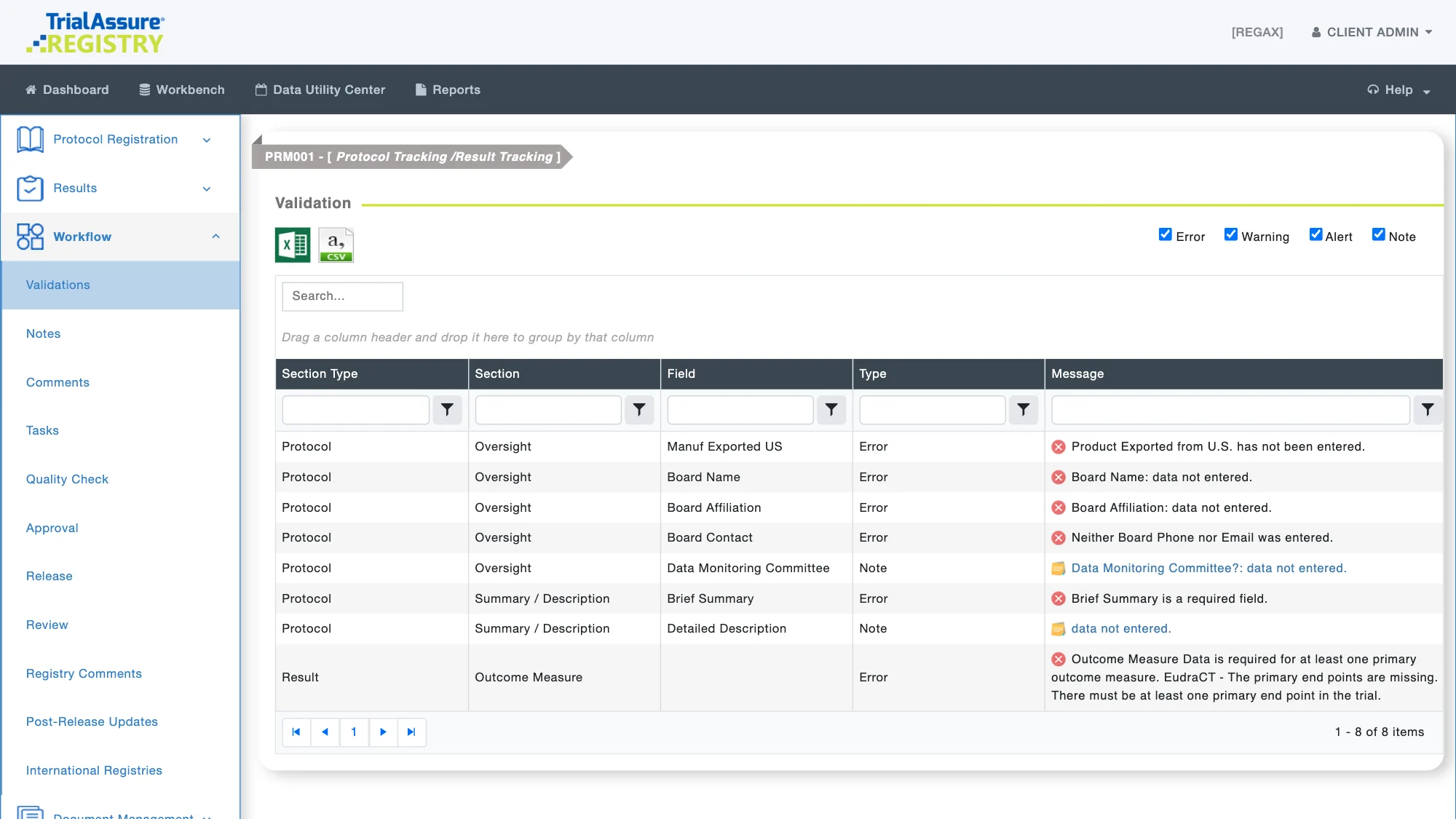
REGISTRY tracks both clocks from CTMS events and prepares and validates the submissions — customers improved 21-day registration performance by 50%. Portfolio-wide status stays visible with upcoming obligations attached. Your team approves each posting, and every submission, timestamp, and change is logged: AI Enabled. Human Driven.™ Do it with software, with our specialists alongside, or hand us the portfolio.
FDAAA 801 / ClinicalTrials.gov — frequently asked questions
What are the penalties for missing ClinicalTrials.gov requirements?
Civil monetary penalties of up to $15,107 per day of violation, assessed under 21 U.S.C. 333(f)(3)(B) once the correction windows close. The sequence matters more than the headline number: FDA first issues a Preliminary Notice of Noncompliance and allows 30 days to correct; if that lapses, a formal Notice of Noncompliance follows with another 30 calendar days; only after that can penalties be assessed, alongside possible injunction or criminal prosecution. The reputational exposure lands first, because FDA publishes those notices in its public enforcement table where partners, investors and journalists can find them long before any money is at stake.
What triggers the 21-day rule in the FDAAA 801 requirements?
Enrollment of the first participant in an applicable clinical trial starts the clock, and initial ClinicalTrials.gov registration is due within 21 calendar days (42 CFR 11.24(a)). The trigger is the day the first participant enrolls — not the day the registry team hears about it — so the date has to arrive from CTMS enrollment events rather than a monthly status call. Missing the window is one of the most common early compliance failures, and it is not quietly recoverable: the registration date sits on the public record, and TrialAssure REGISTRY® is built to watch the trigger instead of the calendar.
When are results due?
Summary results are generally due within 12 months of the primary completion date under 42 CFR 11.44(a). Two mechanisms can move that date, and neither is automatic: a certification of delayed submission for an unapproved product or unapproved new use, and a good-cause extension request under 42 CFR 11.44(e), which NIH grants or denies. Both must be filed before the standard deadline expires. Budget for the build as well — ClinicalTrials.gov results are mostly structured data tables, plus the protocol and statistical analysis plan, and NLM’s quality-control review can send a submitted record back for correction, which consumes calendar time you no longer have.
How do most teams fall out of FDAAA compliance?
Late awareness of trigger events, plus manual tracking. First-participant-in and primary completion are recorded in clinical operations systems; when the registry team hears about them on a monthly status call, part of the 21-day or 12-month window is already spent. Only ~41% of applicable U.S. trials met their ClinicalTrials.gov results reporting deadline in the Lancet’s analysis. The other two failure points are the applicability determination — deciding and documenting which studies are applicable clinical trials under 42 CFR 11.22 — and evidence, because a Pre-Notice gives you 30 days to demonstrate correction. Automating the clocks and keeping a submission log is the fix.
Does FDAAA 801 apply to Phase 1 trials?
No — Phase 1 drug trials and small feasibility device studies are excluded from the applicable clinical trial definition in 42 CFR Part 11. Two caveats: separate NIH policy requires registration and results reporting for any NIH-funded clinical trial, including Phase 1, and the EU CTR covers Phase 1 trials conducted in the EU/EEA. Exempt in the US does not mean exempt everywhere — the determination has to be made per study, per jurisdiction.
Does FDAAA 801 apply to trials conducted entirely outside the United States?
Only when the trial has a US nexus. An overseas study becomes an applicable clinical trial if it has at least one site in the US or a US territory, is conducted under an FDA IND or IDE, or studies a product manufactured in the US and exported for research. A trial with none of those links falls outside FDAAA 801 — though other regimes, such as the EU CTR, may still require disclosure.
Can results submission be delayed if the product is not yet approved?
Yes. If the trial studies an unapproved, unlicensed, or uncleared product — or an unapproved new use — the responsible party can file a certification of delayed submission under 42 CFR 11.44(b)-(c). Results are then due 30 days after FDA approval, licensure, or clearance, or 2 years after the certification date, whichever comes first. Only one certification is allowed per trial, and a separate good-cause extension exists. REGISTRY tracks certification clocks alongside the standard 12-month deadline.
Who is the responsible party for ClinicalTrials.gov submissions?
The sponsor, by default. Under 42 CFR Part 11 the sponsor is the responsible party unless it formally designates a qualified principal investigator, and for trials run under an IND or IDE the IND/IDE holder is considered the sponsor. The designation matters because Pre-Notices, Notices of Noncompliance, and civil money penalties attach to the responsible party of record — not to CROs or collaborators.
Has FDA ever actually fined anyone under FDAAA 801?
Not yet — FDA’s public enforcement table lists no civil money penalties assessed. But the machinery is running: 246 Preliminary Notices of Noncompliance posted through June 2026, 8 formal Notices of Noncompliance since 2021, and on March 30, 2026 FDA contacted more than 2,200 sponsors and researchers about missing results across 3,000+ trials. Every uncorrected day carries $15,107 in exposure; the platform keeps that exposure visible portfolio-wide.
Is registering on ClinicalTrials.gov enough to satisfy EU requirements?
No. Meeting ClinicalTrials.gov requirements satisfies US law only. Trials conducted in the EU/EEA must be separately entered in CTIS under Regulation (EU) No 536/2014, with a summary of results due 12 months after the end of the trial (6 months for pediatric studies) plus a layperson summary. The two systems have different data structures, different clocks, and different triggers, so multinational sponsors run parallel disclosure calendars for the same study.
Hand the 21-day clock and the results build to our team
Tell us the shape of the work: how many trials need ClinicalTrials.gov registration, how many results records are due or already past primary completion, and when you need them filed. We come back with who would run it, what the registration record and the structured results tables take, and how fast we can start. A disclosure specialist replies within one business day.